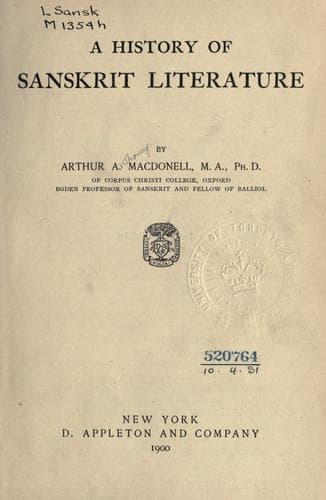
A History of Sanskrit LiteratureMacdonell, Arthur Anthony
History
A History of Sanskrit Literature
Macdonell, Arthur Anthony
Sanskrit literature -- History and criticism
While Kalidasa stands highest in poetical refinement, in tenderness,
and depth of feeling, the author of the Mricchakatika, or "Clay Cart,"
is pre-eminent among Indian playwrights for the distinctively dramatic
qualities of vigour, life, and action, no less than sharpness of
characterisation, being thus allied in genius to Shakespeare. This
play is also marked by originality and good sense. Attributed to
a king named Çudraka, who is panegyrised in the prologue, it is
probably the work of a poet patronised by him, perhaps Dandin, as
Professor Pischel thinks. In any case, it not improbably belongs
to the sixth century. It is divided into ten acts, and belongs to
the dramatic class called prakarana. The name has little to do with
the play, being derived from an unimportant episode of the sixth
act. The scene is laid in Ujjayini and its neighbourhood. The number
of characters appearing on the stage is very considerable. The chief
among them are Charudatta, a Brahman merchant who has lost all his
property by excessive liberality, and Vasantasena, a rich courtesan
who loves the poor but noble Charudatta, and ultimately becomes his
wife. The third act contains a humorous account of a burglary, in
which stealing is treated as a fine art. In the fourth act there is a
detailed description of the splendours of Vasantasena's palace. Though
containing much exaggeration, it furnishes an interesting picture of
the kind of luxury that prevailed in those days. Altogether this play
abounds in comic situations, besides containing many serious scenes,
some of which even border on the tragic.
To the first half of the seventh century belong the two dramas
attributed to the famous King Çriharsha or Harshadeva, a patron
of poets, whom we already know as Harshavardhana of Thaneçar and
Kanauj. Ratnavali, or "The Pearl Necklace," reflecting the court and
harem life of the age, has many points of similarity with Kalidasa's
Malavikagnimitra, by which, indeed, its plot was probably suggested. It
is the story of the loves of Udayana, king of Vatsa, and of Sagarika,
an attendant of his queen Vasavadatta. The heroine ultimately turns
out to be Ratnavali, princess of Ceylon, who had found her way to
Udayana's court after suffering shipwreck. The plot is unconnected
with mythology, but is based on an historical or epic tradition, which
recurs in a somewhat different form in Somadeva's Kathasaritsagara. As
concerned with the second marriage of the king, it forms a sequel to
the popular love-story of Vasavadatta. It is impossible to say whether
the poet modified the main outlines of the traditional story, but the
character of the magician who conjures up a vision of the gods and a
conflagration, is his invention, as well as the incidents, which are
of an entirely domestic nature. The real author was doubtless some
poet resident at Çriharsha's court, possibly Bana, who also wrote a
play entitled Parvatiparinaya.
Public-domain text, read in full here on John Shaqi.
Reviews
Reviews
No reviews yet
Be the first to share your thoughts on this work.
Elsewhere in the archive
Join the Discussion
Join the discussion
Sign in to leave a comment or review.
Sign InorCreate an account