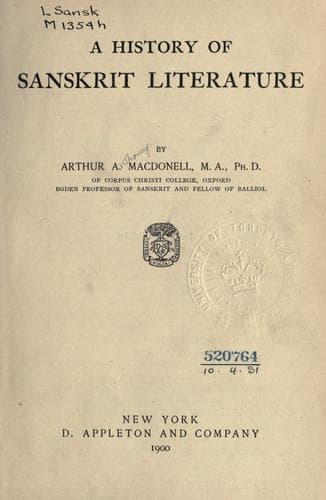
A History of Sanskrit LiteratureMacdonell, Arthur Anthony
History
A History of Sanskrit Literature
Macdonell, Arthur Anthony
Sanskrit literature -- History and criticism
The best known and most popular of Bhavabhuti's plays is
Malati-madhava, a prakarana in ten acts. The scene is laid in Ujjayini,
and the subject is the love-story of Malati, daughter of a minister
of the country, and Madhava, a young scholar studying in the city,
and son of the minister of another state. Skilfully interwoven with
this main story are the fortunes of Makaranda, a friend of Madhava,
and Madayantika, a sister of the king's favourite. Malati and Madhava
meet and fall in love; but the king has determined that the heroine
shall marry his favourite, whom she detests. This plan is frustrated by
Makaranda, who, personating Malati, goes through the wedding ceremony
with the bridegroom. The lovers, aided in their projects by two amiable
Buddhist nuns, are finally united. The piece is a sort of Indian Romeo
and Juliet with a happy ending, the part played by the nun Kamandaki
being analogous to that of Friar Laurence in Shakespeare's drama. The
contrast produced by scenes of tender love, and the horrible doings
of the priestess of the dread goddess Durga, is certainly effective,
but perhaps too violent. The use made of swoons, from which the
recovery is, however, very rapid, is rather too common in this play.
The ninth act contains several fine passages describing the scenery
of the Vindhya range. The following is a translation of one of them:--
This mountain with its towering rocks delights
The eye: its peaks grow dark with gathering clouds;
Its groves are thronged with peacocks eloquent
In joy; the trees upon its slopes are bright
With birds that flit about their nests; the caves
Reverberate the growl of bears; the scent
Of incense-trees is wafted, sharp and cool,
From branches broken off by elephants.
The other two dramas of Bhavabhuti represent the fortunes of the
same national hero, Rama. The plot of the Mahavira-charita, or "The
Fortunes of the Great Hero," varies but slightly from the story told
in the Ramayana. The play, which is divided into seven acts and is
crowded with characters, concludes with the coronation of Rama. The
last act illustrates well how much is left to the imagination of the
spectator. It represents the journey of Rama in an aërial car from
Ceylon all the way to Ayodhya (Oudh) in Northern India, the scenes
traversed being described by one of the company.
Public-domain text, read in full here on John Shaqi.
Reviews
Reviews
No reviews yet
Be the first to share your thoughts on this work.
Elsewhere in the archive
Join the Discussion
Join the discussion
Sign in to leave a comment or review.
Sign InorCreate an account