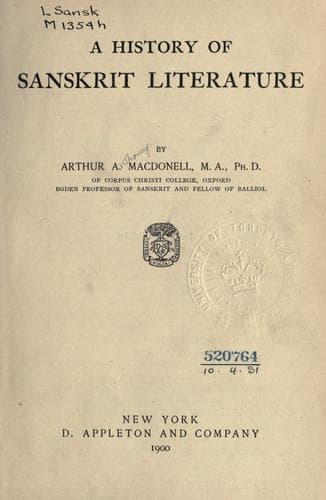
A History of Sanskrit LiteratureMacdonell, Arthur Anthony
History
A History of Sanskrit Literature
Macdonell, Arthur Anthony
Sanskrit literature -- History and criticism
Altogether, Ratnavali is an agreeable play, with well-drawn characters
and many poetical beauties. Of the latter the following lines, in
which the king describes the pale light in the east heralding the
rise of the moon, may serve as a specimen:--
Our minds intent upon the festival,
We saw not that the twilight passed away:
Behold, the east proclaims the lord of night
Still hidden by the mountain where he rises,
Even as a maiden by her pale face shows
That in her inmost heart a lover dwells.
Another play of considerable merit attributed to Çriharsha is
Nagananda. It is a sensational piece with a Buddhistic colouring, the
hero being a Buddhist and Buddha being praised in the introductory
benediction. For this reason its author was probably different from
that of Ratnavali, and may have been Dhavaka, who, like Bana, is
known to have lived at the court of Çriharsha.
The dramatist Bhavabhuti was a Brahman of the Taittiriya school of the
Yajurveda and belonged, as we learn from his prologues, to Vidarbha
(now Berar) in Southern India. He knew the city of Ujjayini well,
and probably spent at least a part of his life there. His patron was
King Yaçovarman of Kanyakubja (Kanauj), who ruled during the first
half of the eighth century.
Three plays by this poet, all abounding in poetic beauties, have come
down to us. They contrast in two or three respects with the works of
the earlier dramatists. The absence of the character of the jester is
characteristic of them, the comic and witty element entering into them
only to a slight extent. While other Indian poets dwell on the delicate
and mild beauties of Nature, Bhavabhuti loves to depict her grand and
sublime aspects, doubtless owing to the influence on his mind of the
southern mountains of his native land. He is, moreover, skilful not
only in drawing characters inspired by tender and noble sentiment,
but in giving effective expression to depth and force of passion.
Public-domain text, read in full here on John Shaqi.
Reviews
Reviews
No reviews yet
Be the first to share your thoughts on this work.
Elsewhere in the archive
Join the Discussion
Join the discussion
Sign in to leave a comment or review.
Sign InorCreate an account