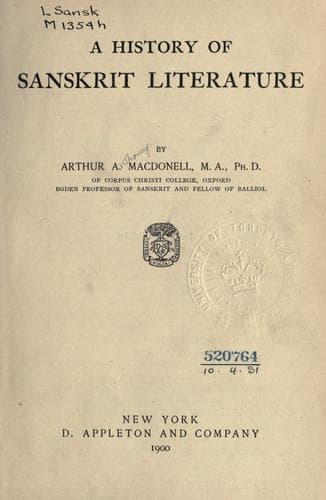
A History of Sanskrit LiteratureMacdonell, Arthur Anthony
History
A History of Sanskrit Literature
Macdonell, Arthur Anthony
Sanskrit literature -- History and criticism
In the eleventh century Damodara Miçra composed the Hanuman-nataka,
"The Play of Hanumat," also called Maha-nataka, or "The Great
Play." According to tradition, he lived at the court of Bhoja, king of
Malava, who resided at Dhara (now Dhar) and Ujjayini (Ujjain) in the
early part of the eleventh century. It is a piece of little merit,
dealing with the story of Rama in connection with his ally Hanumat,
the monkey chief. It consists of fourteen acts, lacking coherence,
and producing the impression of fragments patched together.
Krishna miçra's Prabodha-chandrodaya, or "Rise of the Moon of
Knowledge," a play in six acts, dating from about the end of the
eleventh century, deserves special attention as one of the most
remarkable products of Indian literature. Though an allegorical piece
of theologico-philosophical purport, in which practically only abstract
notions and symbolical figures act as persons, it is remarkable for
dramatic life and vigour. It aims at glorifying orthodox Brahmanism
in the Vishnuite sense, just as the allegorical plays of the Spanish
poet Calderon were intended to exalt the Catholic faith. The Indian
poet has succeeded in the difficult task of creating an attractive
play with abstractions like Revelation, Will, Reason, Religion, by
transforming them into living beings of flesh and blood. The evil
King Error appears on the scene as ruler of Benares, surrounded by
his faithful adherents, the Follies and Vices, while Religion and
the noble King Reason, accompanied by all the Virtues, have been
banished. There is, however, a prophecy that Reason will some day
be re-united with Revelation; the fruit of the union will be True
Knowledge, which will destroy the reign of Error. The struggle for
this union and its consummation, followed by the final triumph of
the good party, forms the plot of the piece.
A large number of Sanskrit plays have been written since the twelfth
century [14] down to modern times, their plots being generally derived
from the Mahabharata and the Ramayana. Besides these, there are farces
in one or more acts, mostly of a coarse type, in which various vices,
such as hypocrisy, are satirised. These later productions reach a
much lower level of art than the works of the early Indian dramatists.
CHAPTER XIV
FAIRY TALES AND FABLES
(Circa 400-1100 A.D.)
The didactic and sententious note which prevails in classical
Sanskrit literature cannot fail to strike the student. It is, however,
specially pronounced in the fairy tales and fables, where the abundant
introduction of ethical reflections and proverbial philosophy is
characteristic. The apologue with its moral is peculiarly subject to
this method of treatment.
Public-domain text, read in full here on John Shaqi.
Reviews
Reviews
No reviews yet
Be the first to share your thoughts on this work.
Elsewhere in the archive
Join the Discussion
Join the discussion
Sign in to leave a comment or review.
Sign InorCreate an account