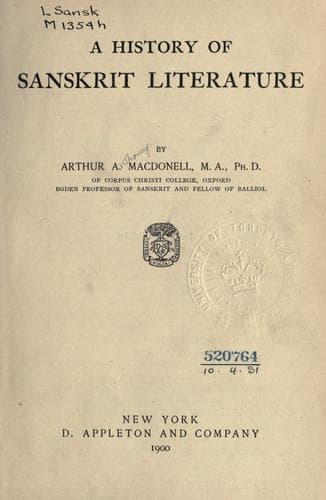
A History of Sanskrit LiteratureMacdonell, Arthur Anthony
History
A History of Sanskrit Literature
Macdonell, Arthur Anthony
Sanskrit literature -- History and criticism
A distinguishing feature of the Sanskrit collections of fairy tales
and fables, which are to a considerable extent found mixed together,
is the insertion of a number of different stories within the framework
of a single narrative. The characters of the main story in turn relate
various tales to edify one another or to prove the correctness of their
own special views. As within the limits of a minor story a second
one can be similarly introduced and the process further repeated,
the construction of the whole work comes to resemble that of a set
of Chinese boxes. This style of narration was borrowed from India by
the neighbouring Oriental peoples of Persia and Arabia, who employed
it in composing independent works. The most notable instance is,
of course, the Arabian Nights.
The Panchatantra, so called because it is divided into five books, is,
from the literary point of view, the most important and interesting
work in this branch of Indian literature. It consists for the most part
of fables, which are written in prose with an admixture of illustrative
aphoristic verse. At what time this collection first assumed definite
shape, it is impossible to say. We know, however, that it existed in
the first half of the sixth century A.D., since it was translated by
order of King Khosru Anushirvan (531-79) into Pehlevi, the literary
language of Persia at that time. We may, indeed, assume that it was
known in the fifth century; for a considerable time must have elapsed
before it became so famous that a foreign king desired its translation.
Public-domain text, read in full here on John Shaqi.
Reviews
Reviews
No reviews yet
Be the first to share your thoughts on this work.
Elsewhere in the archive
Join the Discussion
Join the discussion
Sign in to leave a comment or review.
Sign InorCreate an account