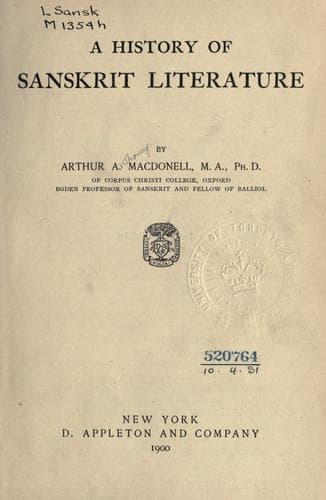
A History of Sanskrit LiteratureMacdonell, Arthur Anthony
History
A History of Sanskrit Literature
Macdonell, Arthur Anthony
Sanskrit literature -- History and criticism
A third work of the same kind is the Çuka-saptati, or "Seventy Stories
of a Parrot." Here a wife, whose husband is travelling abroad, and
who is inclined to run after other men, turns to her husband's clever
parrot for advice. The bird, while seeming to approve of her plans,
warns her of the risks she runs, and makes her promise not to go and
meet any paramour unless she can extricate herself from difficulties
as So-and-so did. Requested to tell the story, he does so, but only
as far as the dilemma, when he asks the woman what course the person
concerned should take. As she cannot guess, the parrot promises to
tell her if she stays at home that night. Seventy days pass in the
same way, till the husband returns.
These three collections of fairy tales are all written in prose and are
comparatively short. There is, however, another of special importance,
which is composed in verse and is of very considerable length. For
it contains no less than 22,000 çlokas, equal to nearly one-fourth of
the Mahabharata, or to almost twice as much as the Iliad and Odyssey
put together. This is the Katha-sarit-sagara, or "Ocean of Rivers
of Stories." It is divided into 124 chapters, called tarangas, or
"waves," to be in keeping with the title of the work. Independent of
these is another division into eighteen books called lambakas.
The author was Somadeva, a Kashmirian poet, who composed his work
about 1070 A.D. Though he himself was a Brahman, his work contains
not only many traces of the Buddhistic character of his sources,
but even direct allusions to Buddhist Birth Stories. He states the
real basis of his work to have been the Brihat-katha, or "Great
Narration," which Bana mentions, by the poet Gunadhya, who is quoted
by Dandin. This original must, in the opinion of Bühler, go back to
the first or second century A.D.
A somewhat earlier recast of this work was made about A.D. 1037 by a
contemporary of Somadeva's named Kshemendra Vyasadasa. It is entitled
Brihat-katha-manjari, and is only about one-third as long as the
Katha-sarit-sagara. Kshemendra and Somadeva worked independently
of each other, and both state that the original from which they
translated was written in the paiçachi bhasha or "Goblin language,"
a term applied to a number of Low Prakrit dialects spoken by the most
ignorant and degraded classes. The Katha-sarit-sagara also contains
(Tarangas 60-64) a recast of the first three books of the Panchatantra,
which books, it is interesting to find, had the same form in Somadeva's
time as when they were translated into Pehlevi (about 570 A.D.).
Public-domain text, read in full here on John Shaqi.
Reviews
Reviews
No reviews yet
Be the first to share your thoughts on this work.
Elsewhere in the archive
Join the Discussion
Join the discussion
Sign in to leave a comment or review.
Sign InorCreate an account