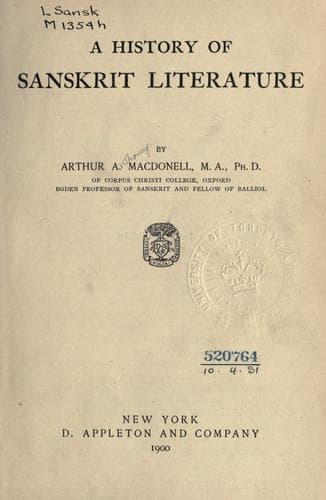
A History of Sanskrit LiteratureMacdonell, Arthur Anthony
History
A History of Sanskrit Literature
Macdonell, Arthur Anthony
Sanskrit literature -- History and criticism
Somadeva's work contains many most entertaining stories; for instance,
that of the king who, through ignorance of the phonetic rules of
Sanskrit grammar, misunderstood a remark made by his wife, and overcome
with shame, determined to become a good Sanskrit scholar or die in
the attempt. One of the most famous tales it contains is that of King
Çibi, who offered up his life to save a pigeon from a hawk. It is a
Jataka, and is often represented on Buddhist sculptures; for example,
on the tope of Amaravati, which dates from about the beginning of
our era. It also occurs in a Chinese as well as a Muhammadan form.
ETHICAL POETRY.
The proneness of the Indian mind to reflection not only produced
important results in religion, philosophy, and science; it also
found a more abundant expression in poetry than the literature of
any other nation can boast. Scattered throughout the most various
departments of Sanskrit literature are innumerable apophthegms in
which wise and noble, striking and original thoughts often appear
in a highly finished and poetical garb. These are plentiful in the
law-books; in the epic and the drama they are frequently on the lips
of heroes, sages, and gods; and in fables are constantly uttered by
tigers, jackals, cats, and other animals. Above all, the Mahabharata,
which, to the pious Hindu, constitutes a moral encyclopædia, is an
inexhaustible mine of proverbial philosophy. It is, however, natural
that ethical maxims should be introduced in greatest abundance into
works which, like the Panchatantra and Hitopadeça, were intended to
be handbooks of practical moral philosophy.
Owing to the universality of this mode of expression in Sanskrit
literature, there are but few works consisting exclusively of
poetical aphorisms. The most important are the two collections by
the highly-gifted Bhartrihari, entitled respectively Nitiçataka,
or "Century of Conduct," and Vairagya-çataka, or "Century
of Renunciation." Others are the Çanti-çataka, or "Century of
Tranquillity," by a Kashmirian poet named Çilhana; the Moha-mudgara,
or "Hammer of Folly," a short poem commending the relinquishment of
worldly desires, and wrongly attributed to Çankaracharya; and the
Chanakya-çataka, the "Centuries of Chanakya," the reputed author of
which was famous in India as a master of diplomacy, and is the leading
character in the political drama Mudra-rakshasa. The Niti-manjari, or
"Cluster of Blossoms of Conduct," which has not yet been published,
is a collection of a peculiar kind. The moral maxims which it contains
are illustrated by stories, and these are taken exclusively from the
Rigveda. It consists of about 200 çlokas, and was composed by an author
named Dya Dviveda who accompanied his work with a commentary. In the
latter he quotes largely from the Brihåddevata, Sayana on the Rigveda,
and other authors.
Public-domain text, read in full here on John Shaqi.
Reviews
Reviews
No reviews yet
Be the first to share your thoughts on this work.
Elsewhere in the archive
Join the Discussion
Join the discussion
Sign in to leave a comment or review.
Sign InorCreate an account