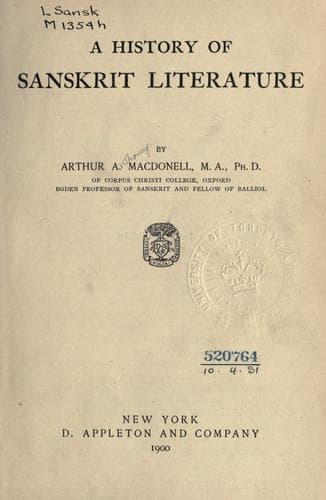
A History of Sanskrit LiteratureMacdonell, Arthur Anthony
History
A History of Sanskrit Literature
Macdonell, Arthur Anthony
Sanskrit literature -- History and criticism
How is the origin of the momentous doctrine which produced this change
to be accounted for? The Rigveda contains no traces of it beyond a
couple of passages in the last book which speak of the soul of a dead
man as going to the waters or plants. It seems hardly likely that
so far-reaching a theory should have been developed from the stray
fancies of one or two later Vedic poets. It seems more probable that
the Aryan settlers received the first impulse in this direction from
the aboriginal inhabitants of India. As is well known, there is among
half-savage tribes a wide-spread belief that the soul after death
passes into the trunks of trees and the bodies of animals. Thus the
Sonthals of India are said even at the present day to hold that the
souls of the good enter into fruit-bearing trees. But among such
races the notion of transmigration does not go beyond a belief
in the continuance of human existence in animals and trees. If,
therefore, the Aryan Indians borrowed the idea from the aborigines,
they certainly deserve the credit of having elaborated out of it
the theory of an unbroken chain of existences, intimately connected
with the moral principle of requïtal. The immovable hold it acquired
on Indian thought is doubtless due to the satisfactory explanation
it offered of the misfortune or prosperity which is often clearly
caused by no action done in this life. Indeed, the Indian doctrine of
transmigration, fantastic though it may appear to us, has the twofold
merit of satisfying the requirement of justice in the moral government
of the world, and at the same time inculcating a valuable ethical
principle which makes every man the architect of his own fate. For,
as every bad deed done in this existence must be expiated, so every
good deed will be rewarded in the next existence. From the enjoyment
of the fruits of actions already done there is no escape; for, in the
words of the Mahabharata, "as among a thousand cows a calf finds its
mother, so the deed previously done follows after the doer."
Public-domain text, read in full here on John Shaqi.
Reviews
Reviews
No reviews yet
Be the first to share your thoughts on this work.
Elsewhere in the archive
Join the Discussion
Join the discussion
Sign in to leave a comment or review.
Sign InorCreate an account