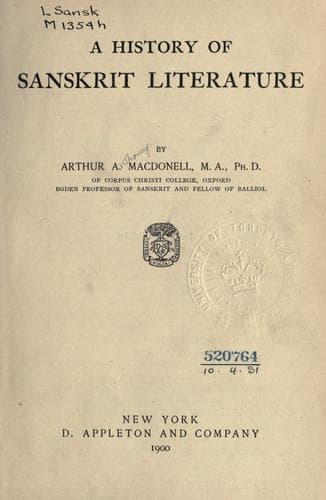
A History of Sanskrit LiteratureMacdonell, Arthur Anthony
History
A History of Sanskrit Literature
Macdonell, Arthur Anthony
Sanskrit literature -- History and criticism
On the Sankhya were based the two heterodox religious systems of
Buddhism and Jainism, which denied the authority of the Veda, and
opposed the Brahman caste system and ceremonial. Still more heterodox
was the Materialist philosophy of Charvaka, which went further and
denied even the fundamental doctrines common to all other schools of
Indian thought, orthodox and unorthodox, the belief in transmigration
dependent on retribution, and the belief in salvation or release
from transmigration.
The theory that every individual passes after death into a series
of new existences in heavens or hells, or in the bodies of men and
animals, or in plants on earth, where it is rewarded or punished for
all deeds committed in a former life, was already so firmly established
in the sixth century B.C., that Buddha received it without question
into his religious system; and it has dominated the belief of the
Indian people from those early times down to the present day. There
is, perhaps, no more remarkable fact in the history of the human mind
than that this strange doctrine, never philosophically demonstrated,
should have been regarded as self-evident for 2500 years by every
philosophical school or religious sect in India, excepting only the
Materialists. By the acceptance of this doctrine the Vedic optimism,
which looked forward to a life of eternal happiness in heaven, was
transformed into the gloomy prospect of an interminable series of
miserable existences leading from one death to another. The transition
to the developed view of the Upanishads is to be found in the Çatapatha
Brahmana (above, p. 223).
Public-domain text, read in full here on John Shaqi.
Reviews
Reviews
No reviews yet
Be the first to share your thoughts on this work.
Elsewhere in the archive
Join the Discussion
Join the discussion
Sign in to leave a comment or review.
Sign InorCreate an account