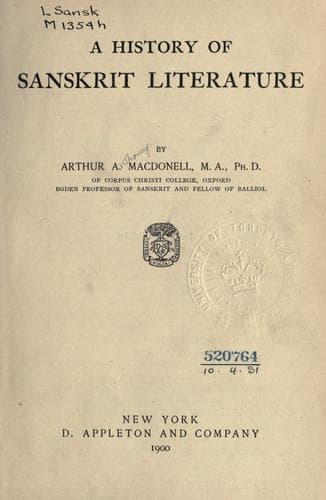
A History of Sanskrit LiteratureMacdonell, Arthur Anthony
History
A History of Sanskrit Literature
Macdonell, Arthur Anthony
Sanskrit literature -- History and criticism
The monistic theory of the early Upanishads, which identified
the individual soul with Brahma, aroused the opposition of the
rationalistic founder of the Sankhya system, Kapila, who, according
to Buddhist legends, was pre-Buddhistic, and whose doctrines Buddha
followed and elaborated. His teaching is entirely dualistic, admitting
only two things, both without beginning and end, but essentially
different, matter on the one hand, and an infinite plurality of
individual souls on the other. An account of the nature and the mutual
relation of these two, forms the main content of the system. Kapila
was, indeed, the first who drew a sharp line of demarcation between
the two domains of matter and soul. The saving knowledge which
delivers from the misery of transmigration consists, according to the
Sankhya system, in recognising the absolute distinction between soul
and matter.
The existence of a supreme god who creates and rules the universe is
denied, and would be irreconcilable with the system. For according
to its doctrine the unconscious matter of Nature originally contains
within itself the power of evolution (in the interest of souls,
which are entirely passive during the process), while karma alone
determines the course of that evolution. The adherents of the system
defend their atheism by maintaining that the origin of misery presents
an insoluble problem to the theist, for a god who has created and
rules the world could not possibly escape from the reproach of cruelty
and partiality. Much stress is laid by this school in general on the
absence of any cogent proof for the existence of God.
The world is maintained to be real, and that from all eternity; for
the existent can only be produced from the existent. The reality of
an object is regarded as resulting simply from perception, always
supposing the senses of the perceiver to be sound. The world is
described as developing according to certain laws out of primitive
matter (prakriti or pradhana). The genuine philosophic spirit of
its method of rising from the known elements of experience to the
unknown by logical demonstration till the ultimate cause is reached,
must give this system a special interest in the eyes of evolutionists
whose views are founded on the results of modern physical science.
Public-domain text, read in full here on John Shaqi.
Reviews
Reviews
No reviews yet
Be the first to share your thoughts on this work.
Elsewhere in the archive
Join the Discussion
Join the discussion
Sign in to leave a comment or review.
Sign InorCreate an account