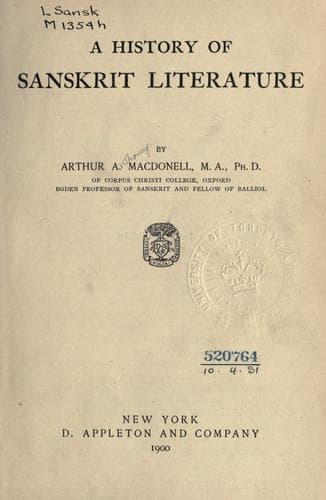
A History of Sanskrit LiteratureMacdonell, Arthur Anthony
History
A History of Sanskrit Literature
Macdonell, Arthur Anthony
Sanskrit literature -- History and criticism
The evolution and diversity of the world are explained by primæval
matter, although uniform and indivisible, consisting of three different
substances called gunas or constituents (originally "strands" of a
rope). By the combination of these in varying proportions the diverse
material products were supposed to have arisen. The constituent,
called sattva, distinguished by the qualities of luminousness and
lightness in the object, and by virtue, benevolence, and other pleasing
attributes in the subject, is associated with the feeling of joy;
rajas, distinguished by activity and various hurtful qualities, is
associated with pain; and tamas, distinguished by heaviness, rigidity,
and darkness on the one hand, and fear, unconsciousness, and so forth,
on the other, is associated with apathy. At the end of a cosmic period
all things are supposed to be dissolved into primitive matter, the
alternations of evolution, existence, and dissolution having neither
beginning nor end.
The psychology of the Sankhya system is specially important. Peculiarly
interesting is its doctrine that all mental operations, such as
perception, thinking, willing, are not performed by the soul, but are
merely mechanical processes of the internal organs, that is to say,
of matter. The soul itself possesses no attributes or qualities,
and can only be described negatively. There being no qualitative
difference between souls, the principle of personality and identity
is supplied by the subtile or internal body, which, chiefly formed of
the inner organs and the senses, surrounds and is made conscious by the
soul. This internal body, being the vehicle of merit and demerit, which
are the basis of transmigration, accompanies the soul on its wanderings
from one gross body to another, whether the latter be that of a god,
a man, an animal, or a tree. Conscious life is bondage to pain, in
which pleasure is included by this peculiarly pessimistic system. When
salvation, which is the absolute cessation of pain, is obtained,
the internal body is dissolved into its material elements, and the
soul, becoming finally isolated, continues to exist individually,
but in absolute unconsciousness.
The name of the system, which only begins to be mentioned in the
later Upanishads, and more frequently in the Mahabharata, is derived
from samkhya, "number." There is, however, some doubt as to whether
it originally meant "enumeration," from the twenty-five tattvas or
principles which it sets forth, or "inferential or discriminative"
doctrine, from the method which it pursues.
Public-domain text, read in full here on John Shaqi.
Reviews
Reviews
No reviews yet
Be the first to share your thoughts on this work.
Elsewhere in the archive
Join the Discussion
Join the discussion
Sign in to leave a comment or review.
Sign InorCreate an account