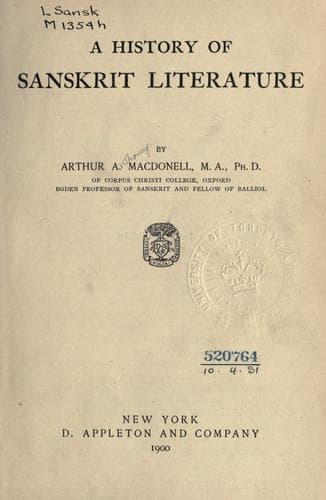
A History of Sanskrit LiteratureMacdonell, Arthur Anthony
History
A History of Sanskrit Literature
Macdonell, Arthur Anthony
Sanskrit literature -- History and criticism
the Vedantic conception of Brahma, in which the individual soul is
merged on attaining salvation.
The importance of these systems lies not in their metaphysical
speculations, which occupy but a subordinate position, but in their
high development of moral principles, which are almost entirely
neglected in the orthodox systems of Indian philosophy. The fate of
the two religions has been strangely different. Jainism has survived
as an insignificant sect in India alone; Buddhism has long since
vanished from the land of its birth, but has become a world religion
counting more adherents than any other faith.
The Sankhya philosophy, with the addition of a peculiar form of mental
asceticism as the most effective means of acquiring saving knowledge,
appears to have assumed definite shape in a manual at an earlier period
than any of the other orthodox systems. This is the Yoga philosophy
founded by Patanjali and expounded in the Yoga Sutras. The priority
of this text-book is rendered highly probable by the fact that it is
the only philosophical Sutra work which contains no polemics against
the others. There seems, moreover, to be no sufficient ground to doubt
the correctness of the native tradition identifying the founder of the
Yoga system with the grammarian Patanjali. The Yoga Sutras therefore
probably date from the second century B.C. This work also goes by
the name of Sankhya-pravachana, the same as that given to the later
Sankhya Sutras, a sufficiently clear proof of its close connection
with Kapila's philosophy. In the Mahabharata the two systems are
actually spoken of as one and the same.
In order to make his system more acceptable, Patanjali introduced into
it the doctrine of a personal god, but in so loose a way as not to
affect the system as a whole. Indeed, the parts of the Sutras dealing
with the person of God are not only unconnected with the other parts of
the treatise, but even contradict the foundations of the system. For
the final aim of man is here represented as the absolute isolation
(kaivalya) of the soul from matter, just as in the Sankhya system,
and not union with or absorption in God. Nor are the individual souls
here derived from the "special soul" or God, but are like the latter
without a beginning.
Public-domain text, read in full here on John Shaqi.
Reviews
Reviews
No reviews yet
Be the first to share your thoughts on this work.
Elsewhere in the archive
Join the Discussion
Join the discussion
Sign in to leave a comment or review.
Sign InorCreate an account