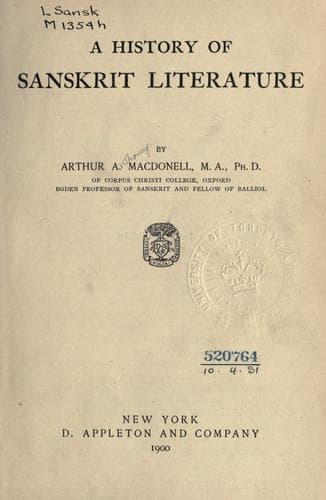
A History of Sanskrit LiteratureMacdonell, Arthur Anthony
History
A History of Sanskrit Literature
Macdonell, Arthur Anthony
Sanskrit literature -- History and criticism
From the beginning of our era down to recent times the Sankhya
doctrines have exercised considerable influence on the religious
and philosophical life of India, though to a much less extent than
the Vedanta. Some of its individual teachings, such as that of the
three gunas, have become the common property of the whole of Sanskrit
literature. At the time of the great Vedantist, Çankara (800 A.D.),
the Sankhya system was held in high honour. The law book of Manu
followed this doctrine, though with an admixture of the theistic
notions of the Mimamsa and Vedanta systems as well as of popular
mythology. The Mahabharata, especially Book XII., is full of Sankhya
doctrines; indeed almost every detail of the teachings of this system
is to be found somewhere in the great epic. Its numerous deviations
from the regular Sankhya text-books are only secondary, as Professor
Garbe thinks, even though the Mahabharata is our oldest actual source
for the system. Nearly half the Puranas follow the cosmogony of the
Sankhya, and even those which are Vedantic are largely influenced
by its doctrines. The purity of the Sankhya notions are, however,
everywhere in the Puranas obscured by Vedanta doctrines, especially
that of cosmical illusion. A peculiarity of the Puranic Sankhya is the
conception of Spirit or Purusha as the male, and Matter or Prakriti
as the female, principle in creation.
On the Sankhya system are based the two philosophical religions of
Buddhism and Jainism in all their main outlines. Their fundamental
doctrine is that life is nothing but suffering. The cause of suffering
is the desire, based on ignorance, to live and enjoy the world. The aim
of both is to redeem mankind from the misery of mundane existence by
the annihilation of desire, with the aid of renunciation of the world
and the practice of unbounded kindness towards all creatures. These
two pessimistic religions are so extremely similar that the Jainas, or
adherents of Jina, were long looked upon as a Buddhist sect. Research
has, however, led to the discovery that the founders of both systems
were contemporaries, the most eminent of the many teachers who in the
sixth century opposed the Brahman ceremonial and caste pretensions
in Northern Central India. Both religions, while acknowledging the
lower and ephemeral gods of Brahmanism, deny, like the Sankhya,
the existence of an eternal supreme Deity. As they developed, they
diverged in various respects from the system to which they owed
their philosophical notions. Hence it came about that Sankhya writers
stoutly opposed some of their teachings, particularly the Buddhist
denial of soul, the doctrine that all things have only a momentary
existence, and that salvation is an annihilation of self. Here,
however, it should be noted that Buddha himself refused to decide the
question whether nirvana is complete extinction or an unending state
of unconscious bliss. The latter view was doubtless a concession to
Public-domain text, read in full here on John Shaqi.
Reviews
Reviews
No reviews yet
Be the first to share your thoughts on this work.
Elsewhere in the archive
Join the Discussion
Join the discussion
Sign in to leave a comment or review.
Sign InorCreate an account