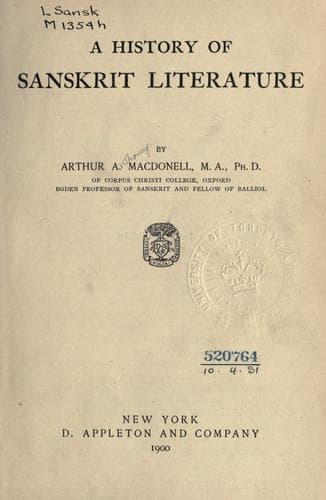
A History of Sanskrit LiteratureMacdonell, Arthur Anthony
History
A History of Sanskrit Literature
Macdonell, Arthur Anthony
Sanskrit literature -- History and criticism
Among the eight branches of Yoga practice the sitting posture (asana),
as not only conducive to concentration, but of therapeutic value,
is considered important. In describing its various forms later
writers positively revelled, eighty-four being frequently stated to
be their normal number. In the hatha-yoga there are also a number of
other postures and contortions of the limbs designated mudra. The
best-known mudra, called khechari, consists in turning the tongue
back towards the throat and keeping the gaze fixed on a point between
the eyebrows. Such practices, in conjunction with the suppression of
breath, were capable of producing a condition of trance. There is at
least the one well-authenticated case of a Yogi named Haridas who in
the thirties wandered about in Rajputana and Lahore, allowing himself
to be buried for money when in the cataleptic condition. The burial
of the Master of Ballantrae by the Indian Secundra Dass in Stevenson's
novel was doubtless suggested by an account of this ascetic.
In contrast with the two older and intimately connected dualistic
schools of the Sankhya and Yoga, there arose about the beginning of
our era the only two, even of the six orthodox systems of philosophy,
which were theistic from the outset. One of them, being based on
the Vedas and the Brahmanas, is concerned with the practical side
of Vedic religion; while the other, alone among the philosophical
systems, represents a methodical development of the fundamental
non-dualistic speculations of the Upanishads. The former, which has
only been accounted a philosophical system at all because of its
close connection with the latter, is the Purva-mimamsa or "First
Inquiry," also called Karma-mimamsa or "Inquiry concerning Works,"
but usually simply Mimamsa. Founded by Jaimini, and set forth in the
Karma-mimamsa Sutras, this system discusses the sacred ceremonies and
the rewards resulting from their performance. Holding the Veda to be
uncreated and existent from all eternity, it lays special stress on the
proposition that articulate sounds are eternal, and on the consequent
doctrine that the connection of a word with its sense is not due to
convention, but is by nature inherent in the word itself. Owing to
its lack of philosophical interest, this system has not as yet much
occupied the attention of European scholars.
The oldest commentary in existence on the Mimamsa Sutras is the
bhashya of Çabara Svamin, which in its turn was commented on about 700
A.D. by the great Mimamsist Kumarila in his Tantra-varttika and in his
Çloka-varttika, the latter a metrical paraphrase of Çabara's exposition
of the first aphorism of Patanjali. Among the later commentaries on the
Mimamsa Sutras the most important is the Jaiminiya-nyaya-mala-vistara
of Madhava (fourteenth century).
Public-domain text, read in full here on John Shaqi.
Reviews
Reviews
No reviews yet
Be the first to share your thoughts on this work.
Elsewhere in the archive
Join the Discussion
Join the discussion
Sign in to leave a comment or review.
Sign InorCreate an account