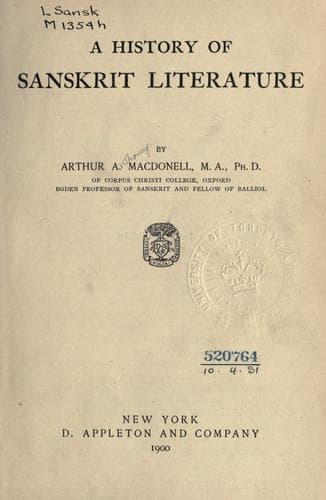
A History of Sanskrit LiteratureMacdonell, Arthur Anthony
History
A History of Sanskrit Literature
Macdonell, Arthur Anthony
Sanskrit literature -- History and criticism
Far more deserving of attention is the theoretical system of the
Uttara-Mimamsa, or "Second Inquiry." For it not only systematises
the doctrines of the Upanishads--therefore usually termed Vedanta,
or "End of the Veda"--but also represents the philosophical views of
the Indian thinkers of to-day. In the words of Professor Deussen,
its relation to the earlier Upanishads resembles that of Christian
dogmatics to the New Testament. Its fundamental doctrine, expressed
in the famous formula tat tvam asi, "thou art that," is the identity
of the individual soul with God (brahma). Hence it is also called
the Brahma- or Çariraka-mimamsa, "Inquiry concerning Brahma or the
embodied soul." The eternal and infinite Brahma not being made up of
parts or liable to change, the individual soul, it is here laid down,
cannot be a part or emanation of it, but is the whole indivisible
Brahma. As there is no other existence but Brahma, the Vedanta
is styled the advaita-vada, or "doctrine of non-duality," being,
in other words, an idealistic monism. The evidence of experience,
which shows a multiplicity of phenomena, and the statements of the
Veda, which teach a multiplicity of souls, are brushed aside as the
phantasms of a dream which are only true till waking takes place.
The ultimate cause of all such false impressions is avidya or innate
ignorance, which this, like the other systems, simply postulates, but
does not in any way seek to account for. It is this ignorance which
prevents the soul from recognising that the empirical world is mere
maya or illusion. Thus to the Vedantist the universe is like a mirage,
which the soul under the influence of desire (trishna or "thirst")
fancies it perceives, just as the panting hart sees before it sheets
of water in the fata morgana (picturesquely called mriga-trishna or
"deer-thirst" in Sanskrit). The illusion vanishes as if by magic,
when the scales fall from the eyes, on the acquisition of true
knowledge. Then the semblance of any distinction between the soul
and God disappears, and salvation (moksha), the chief end of man,
is attained.
Public-domain text, read in full here on John Shaqi.
Reviews
Reviews
No reviews yet
Be the first to share your thoughts on this work.
Elsewhere in the archive
Join the Discussion
Join the discussion
Sign in to leave a comment or review.
Sign InorCreate an account