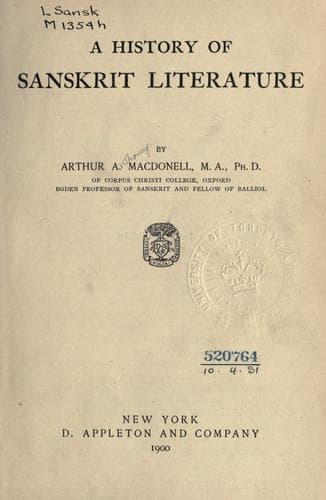
A History of Sanskrit LiteratureMacdonell, Arthur Anthony
History
A History of Sanskrit Literature
Macdonell, Arthur Anthony
Sanskrit literature -- History and criticism
The last two orthodox systems of philosophy, the Vaiçeshika and the
Nyaya, form a closely-connected pair, since a strict classification
of ideas, as well as the explanation of the origin of the world from
atoms, is common to both. Much the older of the two is the Vaiçeshika,
which is already assailed in the Brahma-sutras. It is there described
as undeserving of attention, because it had no adherents. This was
certainly not the case in later times, when this system became very
popular. It received its name from the category of "particularity"
(viçesha) on which great stress is laid in its theory of atoms. The
memory of its founder is only preserved in his nickname Kanada (also
Kanabhuj or Kana-bhaksha), which means "atom-eater."
The main importance of the system lies in the logical categories
which it set up and under which it classed all phenomena. The six
which it originally set up are substance, quality, motion, generality,
particularity, and inherence. They are rigorously defined and further
subdivided. The most interesting is that of inherence or inseparable
connection (samavaya), which, being clearly distinguished from that
of accident or separable connection (samyoga), is described as the
relation between a thing and its properties, the whole and its parts,
genus and species, motion and the object in motion. Later was added a
seventh, that of non-existence (abhava), which, by affording special
facilities for the display of subtlety, has had a momentous influence
on Indian logic. This category was further subdivided into prior and
posterior non-existence (which we should respectively call future and
past existence), mutual non-existence (as between a jar and cloth),
and absolute non-existence (as fire in water).
Though largely concerned with these categories, the Vaiçeshika system
aimed at attaining a comprehensive philosophic view in connection
with them. Thus while dealing with the category of "substance,"
it develops its theory of the origin of the world from atoms. The
consideration of the category of "quality" similarly leads to its
treatment of psychology, which is remarkable and has analogies with
that of the Sankhya. Soul is here regarded as without beginning
or end, and all-pervading, subject to the limitations of neither
time nor space. Intimately connected with soul is "mind" (manas),
the internal organ of thought, which alone enables the soul to know
not only external objects but its own qualities. As this organ is, in
contrast with soul, an atom, it can only comprehend a single object
at any given moment. This is the explanation why the soul cannot be
conscious of all objects simultaneously.
Public-domain text, read in full here on John Shaqi.
Reviews
Reviews
No reviews yet
Be the first to share your thoughts on this work.
Elsewhere in the archive
Join the Discussion
Join the discussion
Sign in to leave a comment or review.
Sign InorCreate an account