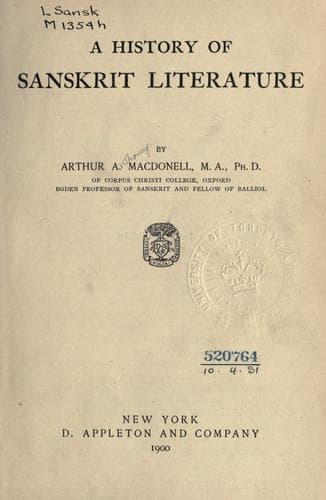
A History of Sanskrit LiteratureMacdonell, Arthur Anthony
History
A History of Sanskrit Literature
Macdonell, Arthur Anthony
Sanskrit literature -- History and criticism
The Nyaya system is only a development and complement of that of
Kanada, its metaphysics and psychology being the same. Its specific
character consists in its being a very detailed and acute exposition of
formal logic. As such it has remained the foundation of philosophical
studies in India down to the present day. Besides dealing fully with
the means of knowledge, which it states to be perception, inference,
analogy, and trustworthy evidence, it treats exhaustively of syllogisms
and fallacies. It is interesting to note that the Indian mind here
independently arrived at an exposition of the syllogism as the form of
deductive reasoning. The text-book of this system is the Nyaya-sutra of
Gotama. The importance here attached to logic appears from the very
first aphorism, which enumerates sixteen logical notions with the
remark that salvation depends on a correct knowledge of their nature.
Neither the Vaiçeshika nor the Nyaya-sutras originally accepted the
existence of God; and though both schools later became theistic,
they never went so far as to assume a creator of matter. Their
theology is first found developed in Udayanacharya's Kusumanjali,
which was written about 1200 A.D., and in works which deal with the
two systems conjointly. Here God is regarded as a "special" soul, which
differs from all other individual eternal souls by exemption from all
qualities connected with transmigration, and by the possession of the
power and knowledge qualifying him to be a regulator of the universe.
Of the eclectic movement combining Sankhya, Yoga, and Vedanta
doctrines, the oldest literary representative is the Çvetaçvatara
Upanishad. More famous is the Bhagavadgita in which the Supreme
Being incarnate as Krishna expounds to Arjuna his doctrines in this
sense. The burden of his teaching is that the zealous performance
of his duty is a man's most important task, to whatever caste he may
belong. The beauty and the power of the language in which this doctrine
is inculcated, is unsurpassed in any other work of Indian literature.
Public-domain text, read in full here on John Shaqi.
Reviews
Reviews
No reviews yet
Be the first to share your thoughts on this work.
Elsewhere in the archive
Join the Discussion
Join the discussion
Sign in to leave a comment or review.
Sign InorCreate an account