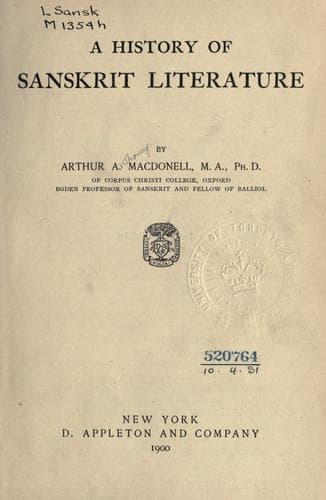
A History of Sanskrit LiteratureMacdonell, Arthur Anthony
History
A History of Sanskrit Literature
Macdonell, Arthur Anthony
Sanskrit literature -- History and criticism
The author of the Sarvadarçana-samgraha, placing himself with
remarkable mental detachment in the position of an adherent in each
case, describes altogether sixteen systems. The six which have not been
sketched above, besides being of little importance, are not purely
philosophic. Five of these are sectarian, one Vishnuite and four
Çivite, all of them being strongly tinctured with Sankhya and Vedanta
doctrines. The sixth, the system of Panini, is classed by Madhava
among the philosophies, simply because the Indian grammarians accepted
the Mimamsa dogma of the eternity of sound, and philosophically
developed the Yoga theory of the sphuta, or the imperceptible and
eternal element inherent in every word as the vehicle of its sense.
CHAPTER XVI
SANSKRIT LITERATURE AND THE WEST
Want of space makes it impossible for me to give even the briefest
account of the numerous and, in many cases, important legal and
scientific works written in Sanskrit. But I cannot conclude this
survey of Sanskrit literature as an embodiment of Indian culture
without sketching rapidly the influence which it has received from and
exercised upon the nations of the West. An adequate treatment of this
highly interesting theme could only be presented in a special volume.
The oldest trace of contact between the Indians and the peoples of
the West is to be found in the history of Indian writing, which,
as we have already seen (p. 16) was derived from a Semitic source,
probably as early as 800 B.C.
The Aryans having conquered Hindustan in prehistoric times,
began themselves to fall under foreign domination from an early
period. The extreme north-west became subject to Persian sway from
about 500 to 331 B.C. under the Achæmenid dynasty. Cyrus the First
made tributary the Indian tribes of the Gandharas and Açvakas. The
old Persian inscriptions of Behistun and Persepolis show that his
successor, Darius Hystaspis, ruled over not only the Gandharians,
but also the people of the Indus. Herodotus also states that this
monarch had subjected the "Northern Indians." At the command of the
same Darius, a Greek named Skylax is said to have travelled in India,
and to have navigated the Indus in 509 B.C. From his account various
Greek writers, among them Herodotus, derived their information about
India. In the army which Xerxes led against Greece in 480 B.C. there
were divisions of Gandharians and Indians, whose dress and equipment
are described by Herodotus. That historian also makes the statement
that the satrapy of India furnished the heaviest tribute in the Persian
empire, adding that the gold with which it was paid was brought from
a desert in the east, where it was dug up by ants larger than foxes.
Public-domain text, read in full here on John Shaqi.
Reviews
Reviews
No reviews yet
Be the first to share your thoughts on this work.
Elsewhere in the archive
Join the Discussion
Join the discussion
Sign in to leave a comment or review.
Sign InorCreate an account