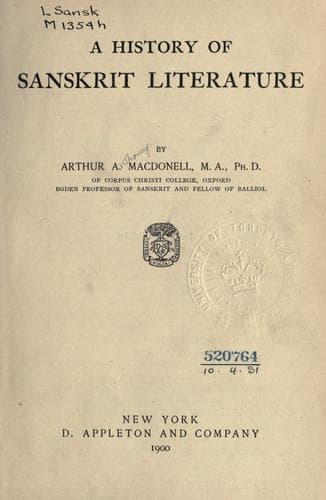
A History of Sanskrit LiteratureMacdonell, Arthur Anthony
History
A History of Sanskrit Literature
Macdonell, Arthur Anthony
Sanskrit literature -- History and criticism
By the side of the orthodox systems and the two non-Brahmanical
religions, flourished the lokayata ("directed to the world of sense"),
or materialistic school, usually called that of the Charvakas from the
name of the founder of the doctrine. It was regarded as peculiarly
heretical, for it not only rejected the authority of the Vedas and
Brahmanic ceremonial, but denied the doctrines of transmigration and
salvation accepted by all other systems. Materialistic teachings
may be traced even before the time of Buddha, and they have had
many secret followers in India down to the present day. The system,
however, seems never to have had more than one text-book, the lost
Sutras of Brihaspati, its mythical founder. Our knowledge of it is
derived partly from the polemics of other schools, but especially from
the Sarvadarçana-samgraha, or "Compendium of all the Philosophical
Systems," composed in the fourteenth century by the well-known
Vedantist Madhavacharya, brother of Sayana. The strong scepticism
of the Charvakas showed itself in the rejection of all the means
of knowledge accepted by other schools, excepting perception. To
them matter was the only reality. Soul they regarded as nothing
but the body with the attribute of intelligence. They held it to
be created when the body is formed by the combination of elements,
just as the power of intoxication arises from the mixture of certain
ingredients. Hence with the annihilation of the body the soul also is
annihilated. Not transmigration, they affirm, but the true nature of
things, is the cause from which phenomena proceed. The existence of
all that transcends the senses they deny, sometimes with an admixture
of irony. Thus the highest being, they say, is the king of the land,
whose existence is proved by the perception of the whole world;
hell is earthly pain produced by earthly causes; and salvation is the
dissolution of the body. Even in the attribution of their text-book to
Brihaspati, the name of the preceptor of the gods, a touch of irony
is to be detected. The religion of the Brahmans receives a severe
handling. The Vedas, say the Charvakas, are only the incoherent
rhapsodies of knaves, and are tainted with the three blemishes of
falsehood, self-contradiction, and tautology; Vedic teachers are
impostors, whose doctrines are mutually destructive; and the ritual of
the Brahmans is useful only as a means of livelihood. "If," they ask,
"an animal sacrificed reaches heaven, why does the sacrificer not
rather offer his own father?"
On the moral side the system is pure hedonism. For the only end of
man is here stated to be sensual pleasure, which is to be enjoyed
by neglecting as far as possible the pains connected with it,
just as a man who desires fish takes the scales and bones into the
bargain. "While life remains, let a man live happily, let him feed on
ghee even though he run into debt; when once the body becomes ashes,
how can it ever return again?"
Public-domain text, read in full here on John Shaqi.
Reviews
Reviews
No reviews yet
Be the first to share your thoughts on this work.
Elsewhere in the archive
Join the Discussion
Join the discussion
Sign in to leave a comment or review.
Sign InorCreate an account