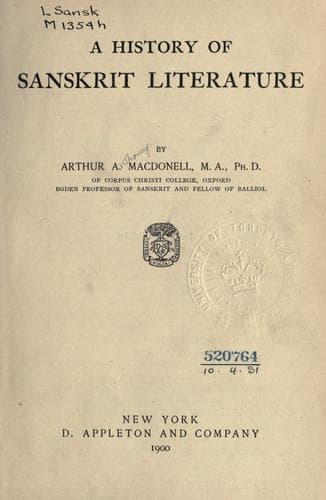
A History of Sanskrit LiteratureMacdonell, Arthur Anthony
History
A History of Sanskrit Literature
Macdonell, Arthur Anthony
Sanskrit literature -- History and criticism
Seleucus, who had founded a kingdom in Media and Persia, feeling
himself unable to vanquish Chandragupta, sent a Greek named Megasthenes
to reside at his court at Pataliputra. This ambassador thus lived
for several years in the heart of India between 311 and 302 B.C.,
and wrote a work entitled Ta Indika, which is particularly valuable
as the earliest direct record of his visit by a foreigner who knew
the country himself. Megasthenes furnishes particulars about the
strength of Chandragupta's army and the administration of the state. He
mentions forest ascetics (Hylobioi), and distinguishes Brachmanes and
Sarmanai as two classes of philosophers, meaning, doubtless, Brahmans
and Buddhists (çramanas). He tells us that the Indians worshipped
the rain-bringing Zeus (Indra) as well as the Ganges, which must,
therefore, have already been a sacred river. By his description of
the god Dionysus, whom they worshipped in the mountains, Çiva must
be intended, and by Herakles, adored in the plains, especially among
the Çurasenas on the Yamuna and in the city of Methora, no other can
be meant than Vishnu and his incarnation Krishna, the chief city of
whose tribe of Yadavas was Mathura (Muttra). These statements seem to
justify the conclusion that Çiva and Vishnu were already prominent as
highest gods, the former in the mountains, the latter in the Ganges
Valley. Krishna would also seem to have been regarded as an Avatar of
Vishnu, though it is to be noted that Krishna is not yet mentioned
in the old Buddhist Sutras. We also learn from Megasthenes that the
doctrine of the four ages of the world (yugas) was fully developed
in India by his time.
Chandragupta's grandson, the famous Açoka, not only maintained his
national Indian empire, but extended it in every direction. Having
adopted Buddhism as the state religion, he did much to spread its
doctrines, especially to Ceylon, which since then has remained the
most faithful guardian of Buddhist tradition.
Public-domain text, read in full here on John Shaqi.
Reviews
Reviews
No reviews yet
Be the first to share your thoughts on this work.
Elsewhere in the archive
Join the Discussion
Join the discussion
Sign in to leave a comment or review.
Sign InorCreate an account