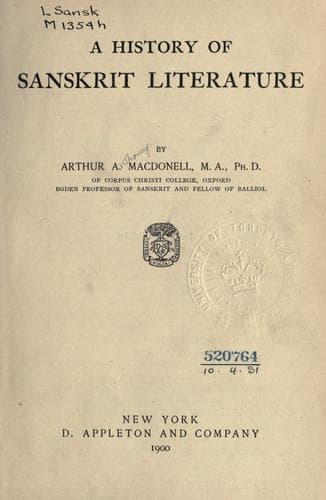
A History of Sanskrit LiteratureMacdonell, Arthur Anthony
History
A History of Sanskrit Literature
Macdonell, Arthur Anthony
Sanskrit literature -- History and criticism
Professor Windisch, however, went further, and maintained such
internal connection. It was, indeed, impossible for him to point out
any affinity to the Greek tragedy, but he thought he could trace in
the Mricchakatika the influence of the new Attic comedy, which reached
its zenith with Menander about 300 B.C. The points in which that play
resembles this later Greek comedy are fewer and slighter in other
Sanskrit dramas, and can easily be explained as independently developed
in India. The improbability of the theory is emphasised by the still
greater affinity of the Indian drama to that of Shakespeare. It is
doubtful whether Greek plays were ever actually performed in India; at
any rate, no references to such performances have been preserved. The
earliest Sanskrit plays extant are, moreover, separated from the Greek
period by at least four hundred years. The Indian drama has had a
thoroughly national development, and even its origin, though obscure,
easily admits of an indigenous explanation. The name of the curtain,
yavanika, may, indeed, be a reminiscence of Greek plays actually seen
in India; but it is uncertain whether the Greek theatre had a curtain
at all; in any case, it did not form the background of the stage.
It is a fact worth noting, that the beginning of one of the most famous
of modern European dramas has been modelled on that of a celebrated
Sanskrit play. The prelude of Çakuntala suggested to Goethe the plan
of the prologue on the stage in Faust, where the stage-manager, the
merryandrew, and the poet converse regarding the play about to be
performed (cf. p. 351). Forster's German translation of Kalidasa's
masterpiece appeared in 1791, and the profound impression it produced
on Goethe is proved by the well-known epigram he composed on Çakuntala
in the same year. The impression was a lasting one; for the theatre
prologue of Faust was not written till 1797, and as late as 1830 the
poet thought of adapting the Indian play for the Weimar stage.
If in epic and dramatic poetry hardly any definite influences can be
traced between India and the West, how different is the case in the
domain of fables and fairy tales! The story of the migration of these
from India certainly forms the most romantic chapter in the literary
history of the world.
Public-domain text, read in full here on John Shaqi.
Reviews
Reviews
No reviews yet
Be the first to share your thoughts on this work.
Elsewhere in the archive
Join the Discussion
Join the discussion
Sign in to leave a comment or review.
Sign InorCreate an account