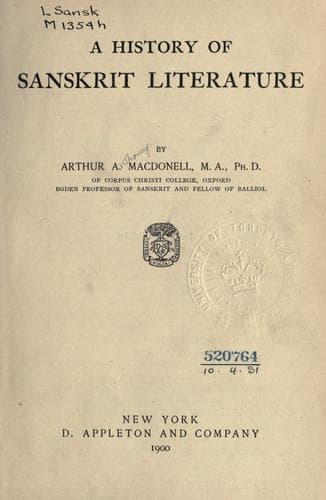
A History of Sanskrit LiteratureMacdonell, Arthur Anthony
History
A History of Sanskrit Literature
Macdonell, Arthur Anthony
Sanskrit literature -- History and criticism
We know that in the sixth century A.D. there existed in India a
Buddhist collection of fables, in which animals play the part
of human beings (cf. p. 369). By the command of the Sassanian
king, Khosru Anushirvan (531-579), this work was translated by a
Persian physician named Barzoi into Pehlevi. Both this version and
the unmodified original have been lost, but two early and notable
translations from the Pehlevi have been preserved. The Syriac one was
made about 570 A.D., and called Kalilag and Damnag. A manuscript of
it was found by chance in 1870, and, becoming known to scholars by
a wonderful chapter of lucky accidents, was published in 1876. The
Arabic translation from the Pehlevi, entitled Kalilah and Dimnah,
or "Fables of Pilpay," was made in the eighth century by a Persian
convert to Islam, who died about 760 A.D. In this translation a
wicked king is represented to be reclaimed to virtue by a Brahman
philosopher named Bidbah, a word which has been satisfactorily traced
through Pehlevi to the Sanskrit vidyapati, "master of sciences,"
"chief scholar." From this bidbah is derived the modern Bidpai or
Pilpay, which is thus not a proper name at all.
This Arabic version is of great importance, as the source of other
versions which exercised very great influence in shaping the literature
of the Middle Ages in Europe. These versions of it were the later
Syriac (c. 1000 A.D.), the Greek (1180), the Persian (c. 1130), recast
later (c. 1494) under the title of Anvar-i-Suhaili, or "Lights of
Canopus," the old Spanish (1251), and the Hebrew one made about 1250.
The fourth stratum of translation is represented by John of Capua's
rendering of the Hebrew version into Latin (c. 1270), entitled
Directorium Humanæ Vitæ which was printed about 1480.
From John of Capua's work was made, at the instance of Duke Eberhardt
of Würtemberg, the famous German version, Das Buch der Byspel der
alten Wysen, or "Book of Apologues of the Ancient Sages," first
printed about 1481. The fact that four dated editions appeared
at Ulm between 1483 and 1485, and thirteen more down to 1592, is
a sufficiently eloquent proof of the importance of this work as a
means of instruction and amusement during the fifteenth and sixteenth
centuries. The Directorium was also the source of the Italian version,
printed at Venice in 1552, from which came the English translation of
Sir Thomas North (1570). The latter was thus separated from the Indian
original by five intervening translations and a thousand years of time.
Public-domain text, read in full here on John Shaqi.
Reviews
Reviews
No reviews yet
Be the first to share your thoughts on this work.
Elsewhere in the archive
Join the Discussion
Join the discussion
Sign in to leave a comment or review.
Sign InorCreate an account