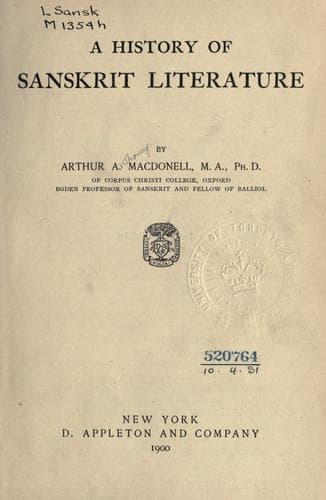
A History of Sanskrit LiteratureMacdonell, Arthur Anthony
History
A History of Sanskrit Literature
Macdonell, Arthur Anthony
Sanskrit literature -- History and criticism
Though Europe was thus undoubtedly indebted to India for its mediæval
literature of fairy tales and fables, the Indian claim to priority
of origin in ancient times is somewhat dubious. A certain number of
apologues found in the collections of Æsop and Babrius are distinctly
related to Indian fables. The Indian claim is supported by the argument
that the relation of the jackal to the lion is a natural one in the
Indian fable, while the connection of the fox and the lion in Greece
has no basis in fact. On the other side it has been urged that animals
and birds which are peculiar to India play but a minor part in Indian
fables, while there exists a Greek representation of the Æsopian fable
of the fox and the raven, dating from the sixth century B.C. Weber and
Benfey both conclude that the Indians borrowed a few fables from the
Greeks, admitting at the same time that the Indians had independent
fables of their own before. Rudimentary fables are found even in
the Chhandogya Upanishad, and the transmigration theory would have
favoured the development of this form of tale; indeed Buddha himself
in the old Jataka stories appears in the form of various animals.
Contemporaneously with the fable literature, the most intellectual game
the world has known began its westward migration from India. Chess
in Sanskrit is called chatur-anga, or the "four-limbed army,"
because it represents a kriegspiel, in which two armies, consisting
of infantry, cavalry, chariots, and elephants, each led by a king
and his councillor, are opposed. The earliest direct mention of
the game in Sanskrit literature is found in the works of Bana, and
the Kavyalamkara of Rudrata, a Kashmirian poet of the ninth century,
contains a metrical puzzle illustrating the moves of the chariot, the
elephant, and the horse. Introduced into Persia in the sixth century,
chess was brought by the Arabs to Europe, where it was generally known
by 1100 A.D. It has left its mark on mediæval poetry, on the idioms
of European languages (e.g. "check," from the Persian shah, "king"),
on the science of arithmetic in the calculation of progressions with
the chessboard, and even in heraldry, where the "rook" often figures
in coats of arms. Beside the fable literature of India, this Indian
game served to while away the tedious life of myriads during the
Middle Ages in Europe.
Public-domain text, read in full here on John Shaqi.
Reviews
Reviews
No reviews yet
Be the first to share your thoughts on this work.
Elsewhere in the archive
Join the Discussion
Join the discussion
Sign in to leave a comment or review.
Sign InorCreate an account