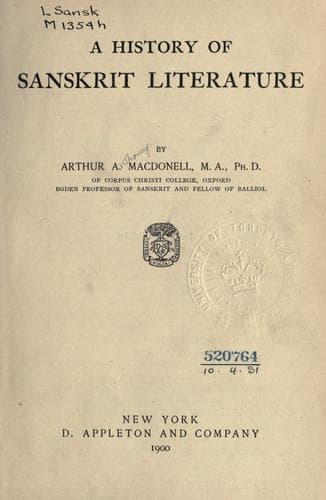
A History of Sanskrit LiteratureMacdonell, Arthur Anthony
History
A History of Sanskrit Literature
Macdonell, Arthur Anthony
Sanskrit literature -- History and criticism
Turning to Philosophical Literature, we find that the early Greek and
Indian philosophers have many points in common. Some of the leading
doctrines of the Eleatics, that God and the universe are one, that
everything existing in multiplicity has no reality, that thinking
and being are identical, are all to be found in the philosophy of
the Upanishads and the Vedanta system, which is its outcome. Again,
the doctrine of Empedocles, that nothing can arise which has not
existed before, and that nothing existing can be annihilated, has
its exact parallel in the characteristic doctrine of the Sankhya
system about the eternity and indestructibility of matter. According
to Greek tradition, Thales, Empedocles, Anaxagoras, Democritus, and
others undertook journeys to Oriental countries in order to study
philosophy. Hence there is at least the historical possibility of
the Greeks having been influenced by Indian thought through Persia.
Whatever may be the truth in the cases just mentioned, the dependence
of Pythagoras on Indian philosophy and science certainly seems to
have a high degree of probability. Almost all the doctrines ascribed
to him, religious, philosophical, mathematical, were known in India
in the sixth century B.C. The coincidences are so numerous that their
cumulative force becomes considerable. The transmigration theory, the
assumption of five elements, the Pythagorean theorem in geometry, the
prohibition as to eating beans, the religio-philosophical character
of the Pythagorean fraternity, and the mystical speculations of
the Pythagorean school, all have their close parallels in ancient
India. The doctrine of metempsychosis in the case of Pythagoras appears
without any connection or explanatory background, and was regarded
by the Greeks as of foreign origin. He could not have derived it
from Egypt, as it was not known to the ancient Egyptians. In spite,
however, of the later tradition, it seems impossible that Pythagoras
should have made his way to India at so early a date, but he could
quite well have met Indians in Persia.
Public-domain text, read in full here on John Shaqi.
Reviews
Reviews
No reviews yet
Be the first to share your thoughts on this work.
Elsewhere in the archive
Join the Discussion
Join the discussion
Sign in to leave a comment or review.
Sign InorCreate an account