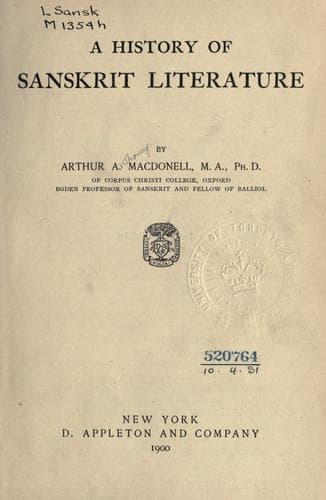
A History of Sanskrit LiteratureMacdonell, Arthur Anthony
History
A History of Sanskrit Literature
Macdonell, Arthur Anthony
Sanskrit literature -- History and criticism
by Thibaut and S. Dvivedi, Benares, 1889), based on five
siddhantas, is a karana or practical astronomical treatise. Another
distinguished astronomer was Brahmagupta, who, born in 598 A.D., wrote,
besides a karana, his Brahma Sphuta-siddhanta when thirty years old
(chaps. xii. and xviii. are mathematical). The last eminent Indian
astronomer was Bhaskaracharya, born in 1114 A.D. His Siddhanta-çiromani
has enjoyed more authority in India than any other astronomical work
except the Surya-siddhanta.
MEDICINE.
Indian medical science must have begun to develop before the beginning
of our era, for one of its chief authorities, Charaka, was, according
to the Chinese translation of the Buddhist Tripitaka, the official
physician of King Kanishka in the first century A.D. His work, the
Charaka-samhita, has been edited several times: by J. Vidyasagara,
2nd ed., Calcutta, 1896, by Gupta, Calcutta, 1897, with comm. by
C. Dutta, Calcutta, 1892-1893; trans. by A. C. Kaviratna, Calcutta,
1897. Suçruta, the next great authority, seems to have lived not
later than the fourth century A.D., as the Bower MS. (probably
fifth century A.D.) contains passages not only parallel to,
but verbally agreeing with, passages in the works of Charaka and
Suçruta. (The Suçruta-samhita, ed. by J. Vidyasagara, Calcutta, 3rd
ed., 1889; A. C. Kaviratna, Calcutta, 1888-95; trans. by Dutta, 1883,
Chattopadhyaya, 1891, Hoernle, 1897, Calcutta.) The next best known
medical writer is Vagbhata, author of the Ashtanga-hridaya (ed.,
with comm. of Arunadatta, by A. M. Kunte, Bombay, Nir. Sag. Press,
1891). Cf. also articles by Haas in vols. xxx., xxxi., and by A. Müller
in xxxiv. of Jour. of Germ. Or. Soc.; P. Cordier, Études sur la
Médecine Hindoue, Paris, 1894; Vagbhata et l'Astangahridaya-samhita,
Besançon, 1896; Liétard, Le Médecin Charaka, &c., in Bull. de l'Ac. de
Médecine, May 11, 1897.
ARTS.
On Indian music see Raja Sir Sourindro Mohun Tagore, Hindu Music
from various Authors, Calcutta, 1875; Ambros, Geschichte der Musik,
vol. i. pp. 41-80; Day, The Music and Musical Instruments of Southern
India and the Deccan, Edinburgh, 1891; Çarngadeva's Samgitaratnakara,
ed. Telang, Anand. Sansk. Ser., 1897; Somanatha's Ragavibodha,
ed. with comm. by P. G. Gharpure (parts i.-v.), Poona, 1895.
On painting and sculpture see E. Moor, The Hindu Pantheon, London,
1810; Burgess, Notes on the Bauddha Rock Temples of Ajanta, Bombay,
1879; Griffiths Paintings of the Buddhist Cave Temples of Ajanta,
2 vols., London, 1896-97; Burgess, The Gandhara Sculptures (with
100 plates), London, 1895; Fergusson, Tree and Serpent Worship
(illustrations of mythology and art in India in the first and
fourth centuries after Christ), London, 1868; Cunningham's Reports,
i. and iii. (Reliefs from Buddha Gaya); Grünwedel, Buddhistiche
Kunst in Indien, Berlin, 1893; Kern, Manual of Buddhism, in Bühler's
Encyclopædia, pp. 91-96, Strasburg, 1896; H. H. Wilson, Ariana Antiqua,
London, 1841.
Public-domain text, read in full here on John Shaqi.
Reviews
Reviews
No reviews yet
Be the first to share your thoughts on this work.
Elsewhere in the archive
Join the Discussion
Join the discussion
Sign in to leave a comment or review.
Sign InorCreate an account