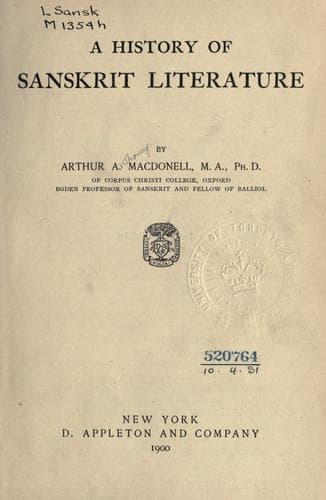
A History of Sanskrit LiteratureMacdonell, Arthur Anthony
History
A History of Sanskrit Literature
Macdonell, Arthur Anthony
Sanskrit literature -- History and criticism
Cf. Sylvain Lévi, Théâtre Indien, pp. 1-21; Regnaud, La Rhétorique
Sanskrite, Paris, 1884; Jacob, Notes on Alamkara Literature, in Journal
of the Roy. As. Soc., 1897, 1898. The oldest and most important work
on poetics is the Natya Çastra of Bharata, which probably goes back
to the sixth century A.D. (ed. in Kavyamala, No. 42, Bombay, 1894;
ed. by Grosset, Lyons, 1897). Dandin's Kavyadarça (end of sixth
century) contains about 650 çlokas (ed. with trans. by Böhtlingk,
Leipsic, 1890). Vamana's Kavyalamkaravritti, probably eighth century
(ed. Cappeller, Jena, 1875). Çringara-tilaka, or "Ornament of Erotics,"
by Rudrabhata (ninth century), ed. by Pischel, Kiel, 1886 (cf. Journal
of German Or. Soc., 1888, p. 296 ff., 425 ff.; Vienna Or. Journal,
ii. p. 151 ff.). Rudrata Çatananda's Kavyalamkara (ed. in Kavyamala)
belongs to the ninth century. Dhanamjaya's Daçarupa, on the ten
kinds of drama, belongs to the tenth century (ed. Hall, 1865;
with comm. Nirnaya Sagara Press, Bombay, 1897). The Kavyaprakaça
by Mammata and Alata dates from about 1100 (ed. in the Pandit,
1897). The Sahityadarpana was composed in Eastern Bengal about 1450
A.D., by Viçvanatha Kaviraja (ed. J. Vidyasagara, Calcutta, 1895;
trans. by Ballantyne in Bibl. Ind.).
MATHEMATICS AND ASTRONOMY.
The only work dealing with this subject as a whole is Thibaut's
Astronomie, Astrologie und Mathematik, in Bühler-Kielhorn's
Encyclopædia, 1899 (full bibliography). See also Cantor, Geschichte
der Mathematik, pp. 505-562, Leipsic, 1880. Mathematics are dealt with
in special chapters of the works of the early Indian astronomers. In
algebra they attained an eminence far exceeding anything ever achieved
by the Greeks. The earliest works of scientific Indian astronomy
(after about 300 A.D.) were four treatises called Siddhantas; only one,
the Suryasiddhanta (ed. and trans. by Whitney, Journ. Am. Or. Soc.,
vol. vi.), has survived. The doctrines of such early works were reduced
to a more concise and practical form by Aryabhata, born, as he tells
us himself, at Pataliputra in 476 A.D. He maintained the rotation
of the earth round its axis (a doctrine not unknown to the Greeks),
and explained the cause of eclipses of the sun and moon. Mathematics
are treated in the third section of his work, the Aryabhatiya
(ed. with comm. by Kern, Leyden, 1874; math. section trans. by Rodet,
Journal Asiatique, 1879). Varaha Mihira, born near Ujjain, began his
calculations about 505 A.D., and, according to one of his commentators,
died in 587 A.D. He composed four works, written for the most part in
the Arya metre; three are astrological: the Brihat-samhita (ed. Kern,
Bibl. Ind., 1864, 1865, trans. in Journ. As. Soc., vol. iv.; new
ed. with comm. of Bhattotpala by S. Dvivedi, Benares, 1895-97),
the Brihaj-jataka (or Hora-çastra, trans. by C. Jyer, Madras, 1885),
and the Laghu-jataka (partly trans. by Weber, Ind. Stud., vol. ii.,
and by Jacobi, 1872). His Pancha-siddhantika (ed. and for the most
part trans.
Public-domain text, read in full here on John Shaqi.
Reviews
Reviews
No reviews yet
Be the first to share your thoughts on this work.
Elsewhere in the archive
Join the Discussion
Join the discussion
Sign in to leave a comment or review.
Sign InorCreate an account