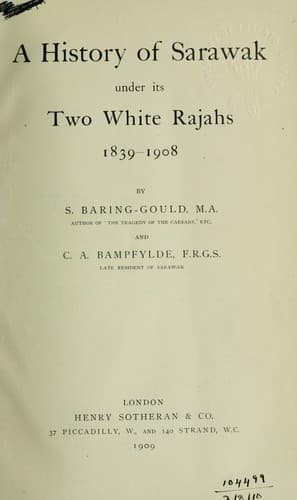
A History of Sarawak under Its Two White Rajahs 1839-1908Baring-Gould, S. (Sabine)
History
A History of Sarawak under Its Two White Rajahs 1839-1908
Baring-Gould, S. (Sabine)
Charles, Rajah of Sarawak, 1829-1917; James, Rajah of Sarawak, 1803-1868; Sarawak (Malaysia) -- History
The Rajah now returned to Sarawak in the _Cruiser_, visiting Bruni on
his way. Here he learnt that two days after he had left the town,
Pangiran Usup, full of rage and resentment, had gathered a force to
attack Bruni and take and kill Pangiran Muda Hasim, and his brother
Pangiran Bedrudin, but the latter met him, inflicted on him a signal
defeat, and Usup was constrained to fly to Kimanis, some seventy-five
miles to the north-east of the capital, over which district he was
feudary lord. Then the two uncles insisted upon their nephew the Sultan
issuing a decree for his execution. This was done, and the order
transmitted to the headman at Kimanis. It was carried out by him with
characteristic perfidy. Pretending to entertain a lively friendship for
the refugee, he seized an opportunity, when Usup had laid aside his
weapons in order to bathe, to fall upon him and strangle him. His
brother, Pangiran Yakub, was executed at the same time.
At the close of 1845, Sarawak was at peace within and without. Trade was
flourishing, and by immigration the population had increased fourfold,
and what had been but a few years before a most miserably oppressed
country was now the happiest and most prosperous in Borneo.
The Rajah felt more secure, but he still wished for a man-of-war to
guard the coast, and, above all, for British protection, and a flag with
the Union cantoned in it.
In October, Sherip Mular, with Sherip Ahmit,[129] was again amongst the
Sekrang Dayaks, and had induced them to go on a piratical expedition
with Sherips Amal, Long, and their father Sherip Abu Bakar, but this
rising the Rajah was easily able to suppress with his own Malays aided
by the Balau Dayaks. The marauders were met and defeated by the Balaus,
who captured their eighteen boats, arms and ammunition, and slew the
Sekrang Dayak chief, Apai Beragai, but the three sherips unfortunately
escaped into the jungle, and fled to Saribas. Timely warning of Sherip
Mular's conduct had been sent the Rajah by the well-disposed Malay and
Dayak chiefs of the Sekrang, of whom there were now many. But the
sherips returned, and again gaining confidence and ascendency over the
well disposed, in February, 1846, the Sekrang Dayaks once more burst
out, and with a force of some 1200 men laid waste the coast, burning
villages, killing men, and carrying women and children into slavery.
They had fortified themselves up the Sekrang, and felt themselves to be
in a position to repel the attack of any force that might be sent
against them.
Public-domain text, read in full here on John Shaqi.
Reviews
Reviews
No reviews yet
Be the first to share your thoughts on this work.
Elsewhere in the archive
Join the Discussion
Join the discussion
Sign in to leave a comment or review.
Sign InorCreate an account