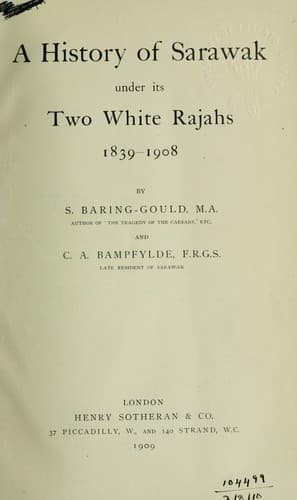
A History of Sarawak under Its Two White Rajahs 1839-1908Baring-Gould, S. (Sabine)
History
A History of Sarawak under Its Two White Rajahs 1839-1908
Baring-Gould, S. (Sabine)
Charles, Rajah of Sarawak, 1829-1917; James, Rajah of Sarawak, 1803-1868; Sarawak (Malaysia) -- History
In the Sadong, on the Rajah's recommendation, a Malay chief named Abang
Kasim had been appointed governor by the Bruni Government in succession
to Sherip Sahap, with the title of Datu Bandar;[130] he was a man weak
in character, but with brains enough to be mischievous and get himself
into trouble; and the Land-Dayaks there were again being so oppressed by
the Malays that the Rajah found it necessary to warn the latter that
they would be punished and turned out of the river if they did not
desist.
The Sea-Dayaks of the Kanowit river, a large affluent of the Rejang
running towards the head of the Sekrang, by reason of their raids on the
Melanaus of Muka, Oya, Matu, and the Rejang delta, now came under the
Rajah's notice. The Datu Patinggi Abdul Rahman,[131] who was the nominal
Bruni governor of this large river, had sent letters to the Rajah
stating his desire to put down piracy; these were accepted as an
expression of good faith, though he was suspected of conniving in these
raids, and the Rajah promised him assistance. The Kanowit Dayaks were
from the Sekrang, and were joined in their expeditions by the Saribas
and Sekrang Dayaks, who marched overland to join them, so as to obtain a
safer outlet to the sea than was now afforded by the mouths of their own
rivers. They had lately destroyed Palo, in the delta, killed the men,
and had carried the women and children into captivity.
After the death of Pangiran Usup it might have been supposed that the
Sultan, feeble and irresolute, would have fallen under the influence of
his uncles, Hasim and Bedrudin, and would have been led to favour the
English alliance, but this was not so. He was angry at the rout of the
pirates of Marudu, and sore at being constrained to sign the death
warrant of Usup, his favourite and adviser; as also at the shrinkage of
the profits derived from the pirates, though at the expense of the lives
and persons of his own subjects. He bore towards Hasim and Bedrudin that
dislike which a narrow and dull mind feels towards those who are morally
and intellectually his superiors, and such as a reigning prince not
infrequently entertains towards the man who will succeed him on his
throne. Accordingly he surrounded himself with a number of scoundrels,
led by one Haji Seman, a man of low birth, the successor of Pangiran
Usup as the Sultan's chief adviser, who fawned on and flattered him, and
to whom he could pour forth his grievances; and these men, many of them
pangirans and chiefs, fanned his animosities, and encouraged him in his
evil courses, for they were still favourable to the piratical party, and
were desirous of avenging the death of Pangiran Usup and the destruction
of Marudu. The princes, especially Hasim, who had recently been publicly
declared successor to the throne by the Sultan, with the title of Sultan
Muda, and Bedrudin, were well aware that they were regarded with
disfavour, and that there was a powerful party against them; they knew
Public-domain text, read in full here on John Shaqi.
Reviews
Reviews
No reviews yet
Be the first to share your thoughts on this work.
Elsewhere in the archive
Join the Discussion
Join the discussion
Sign in to leave a comment or review.
Sign InorCreate an account