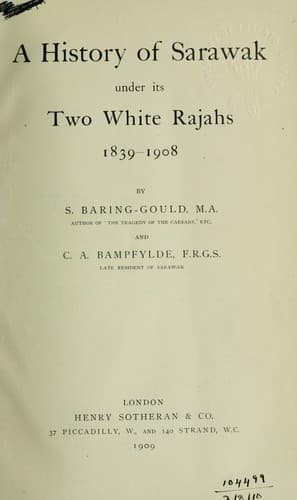
A History of Sarawak under Its Two White Rajahs 1839-1908Baring-Gould, S. (Sabine)
History
A History of Sarawak under Its Two White Rajahs 1839-1908
Baring-Gould, S. (Sabine)
Charles, Rajah of Sarawak, 1829-1917; James, Rajah of Sarawak, 1803-1868; Sarawak (Malaysia) -- History
The Dutch Government had viewed the Rajah's elevation and settlement at
Sarawak, as well as the past and recent operations of the British on the
north-west coast, with unfeigned jealousy, and had, during the last two
years, repeatedly remonstrated with the British Government for
countenancing these proceedings, which the Dutch Minister, by a stretch
of imagination, exaggerated into having been the cause of a general
uneasiness arising in Holland "as to the security and integrity of the
Netherlands possessions in the Eastern Archipelago," and a suspicion of
"the Government having surrendered, or very nearly so, the Eastern
Archipelago to England." Further, "the King's Government," extravagantly
wrote the Minister, "cannot forget how much it has had to suffer at
different epochs in India from the practices of this individual (the
Rajah), whom the Netherlands authorities have everywhere found in their
way, and constantly in opposition to them." In his position as H.M.'s
Political Agent, "combined with his long experience and intimate
knowledge of Borneo," with "his desire to annoy, and his ill-will
towards the Netherlands," the Minister considered him a very
inconvenient and harassing personage to the Netherlanders and their
Government. The Netherlands Government alleged that the Rajah's action
in Sarawak and the occupation of Labuan were an abandonment of the
spirit of the Treaty of 1824, if not of the letter. But by that Treaty
the Dutch sphere of influence in Borneo had been limited to the equator,
north of the line remaining within the sphere of British influence. As
the Minister foresaw, Lord Aberdeen, on these grounds, denied that the
recent measures taken in Borneo were in any way a contravention of the
treaty or inimical to Dutch interests. Lord Aberdeen, in supporting the
Rajah, eulogised him as a gentleman of high character, whose "efforts
have been directed to the furtherance of civilization, to the
discouragement of piratical pursuits, and to the promotion of the
welfare of the native population," and contended that he had obtained
his possessions "in the most legitimate manner." He further implied that
the Rajah's legitimate objects and pursuits having met with undue
interference by the Netherlands authorities, occasion had perhaps been
given for disputes arising between him and the Netherlands Government,
for he was naturally "not favorably disposed to the extension of Dutch
influence in the parts where he had acquired possessions";[144] an
influence which the Governor-General of Netherlands India in his
rescript of January 1846, mentioned in footnote, p. 93, said his
Government did not exercise in the State of the Sultan of Bruni, which
extended from cape Datu to the Kimanis river.
The Rajah wrote:—
Public-domain text, read in full here on John Shaqi.
Reviews
Reviews
No reviews yet
Be the first to share your thoughts on this work.
Elsewhere in the archive
Join the Discussion
Join the discussion
Sign in to leave a comment or review.
Sign InorCreate an account