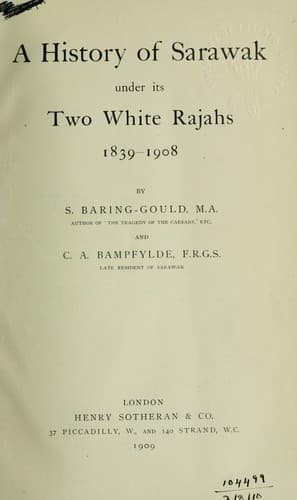
A History of Sarawak under Its Two White Rajahs 1839-1908Baring-Gould, S. (Sabine)
History
A History of Sarawak under Its Two White Rajahs 1839-1908
Baring-Gould, S. (Sabine)
Charles, Rajah of Sarawak, 1829-1917; James, Rajah of Sarawak, 1803-1868; Sarawak (Malaysia) -- History
The Netherlands Government has made an attack upon me, but it has
failed. I am astonished at the misrepresentations to which it
stoops.... I never had any dispute with the Dutch authorities; and
the only communications which have passed between the Resident of
Sambas and myself have been of a most friendly kind.[145]
But though she failed, it was some years before Holland gave up her
pretensions to Sarawak, pretensions which twice before they could have
realised—in 1833, when Pangiran Usup offered her the country, and, a few
years later, when the Sarawak people asked for her protection; but the
one involved a monetary equivalent, and the other military support, and
she thought to acquire the country by cheaper methods, which the Rajah
knew she still meant to do after his death if she could. Without his
influence, and without his influential friends, he did not think that
Sarawak could subsist after he was gone, and this it was that made him
so urgent to be put under British protection. When, finally, the British
Government did recognise Sarawak as an independent State, the
Netherlands Minister was asked if he were aware of the recognition. The
reply was, "Holland will not recognise Sarawak, as the Government is
convinced that Sarawak cannot last beyond the lifetime of Sir James
Brooke." He added, "I told you this seven years ago, and I see no
reason, from recent events, to alter my opinion."[146] This was in 1863.
The early part of 1847 was spent by the Rajah recruiting his health on
Penang hill, where a letter was received from the Sultan notifying that
Haji Seman had given himself up at Bruni, and asking for instructions of
the Admiral and the Rajah as to his disposal. It was not considered that
his execution was now necessary as an example, and the Sultan was
informed that the past could be buried in oblivion, but that misconduct
in the future would revive its recollection.[147]
Public-domain text, read in full here on John Shaqi.
Reviews
Reviews
No reviews yet
Be the first to share your thoughts on this work.
Elsewhere in the archive
Join the Discussion
Join the discussion
Sign in to leave a comment or review.
Sign InorCreate an account