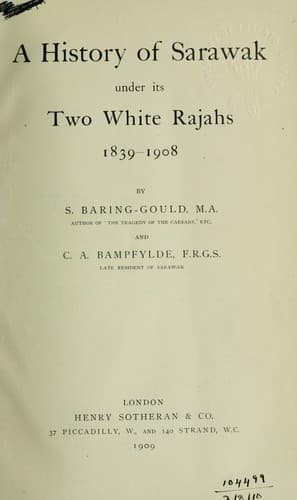
A History of Sarawak under Its Two White Rajahs 1839-1908Baring-Gould, S. (Sabine)
History
A History of Sarawak under Its Two White Rajahs 1839-1908
Baring-Gould, S. (Sabine)
Charles, Rajah of Sarawak, 1829-1917; James, Rajah of Sarawak, 1803-1868; Sarawak (Malaysia) -- History
But trouble far-reaching, on which he had not calculated, was in store
for the Rajah through this expedition. It came at a time when he was
weakened in health from continuous exposure and the severe strain he had
undergone, which had brought him near death's door, and it came from a
quarter the least expected. He "had risked life, given money, and
sacrificed health to effect a great object;"[171] and had made the coast
from cape Datu to Marudu bay as safe as the English Channel to vessels
of all flags and all sizes, and now he had to bear with the malicious
tongues and persecutions of the humanity-mongers of England, who were
first prompted to attack the Rajah by his discarded agent, Mr. Wise.
This man was embittered against the Rajah for his refusal to sell
Sarawak to a company; by being called to account for a loss he had
caused the Rajah of some thousands of pounds; and by some unfavourable
comments the Rajah had made on his actions, which had come to his
knowledge owing to certain private letters of the Rajah not intended for
his eyes having fallen into his hands. Wise had offered to make the
Rajah "one of the richest commoners in England," and presumedly saw his
way to becoming one too, but the Rajah preferred "the real interests of
Sarawak and the plain dictates of duty to the golden baited hook."[172]
Cobden, Hume, Sidney Herbert, and afterwards Gladstone, as well as
others of that faction, took up the cause of the pirates, and the Rajah
and the naval officers who had been engaged since 1843 in suppressing
the Saribas and Sekrangs were attacked with acrimony as butchers of
peaceful and harmless natives—and all for the sake of extending the
Sarawak raj. The _Spectator_ and the _Daily News_ bitterly assailed the
Rajah, relying upon information supplied through the medium of a
Singapore newspaper; and the Peace Society and the Aborigines Protection
Society, laid on a false scent by those whom they should not have
trusted, became scurrilous in their advocacy of cold-blooded murderers
and pirates.
After having brought the "_cruel butchery_" of Beting Maru to the
attention of the House of Commons on three occasions, Joseph Hume, on
July 12, 1850, moved an address to her Majesty, bringing to the notice
of the House "one of the most atrocious massacres that had ever taken
place in his time." He supported the motion with glaring and wilful
mis-statements, and brought disgraceful charges against the Rajah, whom
he branded as "the promoter of deeds of bloodshed and cruelty." The Navy
he charged with wholesale murder, and the poor victims of the massacre
he described as a harmless and timid people.[173]
Cobden, who supported the motion, called the battle of Beting Maru a
human battue, than which there was never anything more unprovoked. He
could not do homage to the Rajah as a great philanthropist seeing that
he had no other argument for the savages than extermination.
Public-domain text, read in full here on John Shaqi.
Reviews
Reviews
No reviews yet
Be the first to share your thoughts on this work.
Elsewhere in the archive
Join the Discussion
Join the discussion
Sign in to leave a comment or review.
Sign InorCreate an account