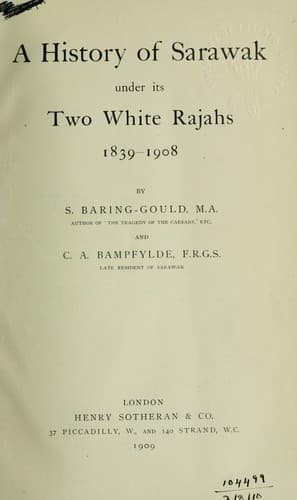
A History of Sarawak under Its Two White Rajahs 1839-1908Baring-Gould, S. (Sabine)
History
A History of Sarawak under Its Two White Rajahs 1839-1908
Baring-Gould, S. (Sabine)
Charles, Rajah of Sarawak, 1829-1917; James, Rajah of Sarawak, 1803-1868; Sarawak (Malaysia) -- History
The Rajah was ably defended by Mr. Henry Drummond, who exposed Wise's
conduct; and the motion was lost by a majority of 140 in a House of 198.
At Birmingham, Cobden asserted that the Rajah, "who had gone out to the
Eastern Archipelago as a private adventurer, had seized upon a territory
as large as Yorkshire, and then drove out the natives; and who, under
the pretence that they were pirates, subsequently sent for our fleet and
men to massacre them ... the atrocities perpetrated by Sir James Brooke
in Borneo had been continually quoted in the Austrian newspapers as
something which threw into the shade the horrible atrocities of Haynau
himself."
The following year, on July 10, Hume moved for a Royal Commission to
enquire into the proceedings of Sir James Brooke, but this was negatived
by 230 votes to 19. He went a little further this time, and drew
harrowing pictures of "cruel butcheries, and brutal murders of the
helpless and defenceless." Sir James Brooke, he said, attacked none but
the poor Dayaks, and even their wives and children were destroyed. He
even went so far as to deny that the Saribas were head-hunters.
Gladstone bore high testimony to the Rajah's character and motives. His
entire confidence in the Rajah's honour and integrity led him to accept
his statements with unqualified and unreserved belief. He adjudged the
Dayaks of being addicted to barbarous warfare and piracy, and maintained
that there were not sufficient grounds for the motion, against which he
voted. He, however, contended that most of the pirates were killed when
not resisting, and had been deliberately sacrificed in the act of
fleeing. This unhappily gave rise to doubts, which subsequently caused
him to entirely change his opinions, and to completely veer round to the
other side.
Lord Palmerston denounced the charges against the Rajah "as malignant
and persevering persecution of an honourable man," and Mr. Drummond
rightly denied "that, from beginning to end, this motion had any other
foundation than a personal determination to ruin Sir James Brooke." "The
whole of this transaction from first to last was a very discreditable
affair," he said. "The gentlemen of England echoed him,"[174] and the
nation too, judging by the tone of the press, which (with the exception
of one or two papers), from _The Times_ downwards, supported the
Rajah.[175]
Her Majesty's Government had notified the Rajah of their approval of all
he had done, and he was instructed to follow the same course should a
similar necessity arise.
But Wise, Hume, Cobden, and their adherents were only checked, and,
huffed by their defeats, continued their efforts to ruin the Rajah's
character and administration with increased bitterness, unfortunately in
the end to obtain a partial success; but we will leave this subject for
a while, to turn briefly to events in Sarawak.
Public-domain text, read in full here on John Shaqi.
Reviews
Reviews
No reviews yet
Be the first to share your thoughts on this work.
Elsewhere in the archive
Join the Discussion
Join the discussion
Sign in to leave a comment or review.
Sign InorCreate an account