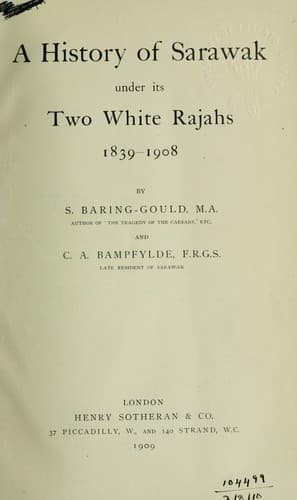
A History of Sarawak under Its Two White Rajahs 1839-1908Baring-Gould, S. (Sabine)
History
A History of Sarawak under Its Two White Rajahs 1839-1908
Baring-Gould, S. (Sabine)
Charles, Rajah of Sarawak, 1829-1917; James, Rajah of Sarawak, 1803-1868; Sarawak (Malaysia) -- History
During the Rajah's absence, an envoy from the United States had arrived
at Kuching bearing a letter from the President addressed to him as
Sovereign Prince of Sarawak, and expressing a desire to enter into
friendly relations. The envoy informed the Rajah by letter that having
been entrusted with full powers he was ready to sign a treaty with
Sarawak, and that he was to thank the Rajah "in the name of the American
nation for his exertions in the suppression of piracy," and to
compliment him on his noble and "humane endeavours to bring his subjects
and the neighbouring tribes of Malays into a condition of civilisation."
Lord Palmerston saw no objection to the Rajah entering into diplomatic
relations as Rajah of Sarawak with the United States.[177]
In January, 1851, the Rajah, leaving Captain Brooke in charge, again
left for England on account of the bad state of his health. He came home
for rest and quiet, but this was denied him, and he had to sum up all
his energies, and expend time and money to contend against the active
and bitter hostility of his Radical opponents in England, who in spite
of adverse majorities in the House of Commons and the opposition of some
of the most prominent politicians in both Houses, continued their
malignant persecution with great persistency both in and out of
Parliament.
In 1853, the Aberdeen coalition Ministry came into power, which, like
all coalitions, was feeble and lived by compromise. This Ministry agreed
to give what Hume and his faction asked, and had thrice been refused by
the House by large majorities,[178] a commission of enquiry into the
conduct of the Rajah, before which he was to be called upon to defend
himself against allegations scouted by the House, the incorrectness of
which could be proved by the leading statesmen of the day, including
such men as the Earl of Derby, Earl Grey, Viscount Palmerston, and Lord
John Russell.[179] The Ministry most disingenuously kept their decision
a secret from the Rajah until after he had left England, though not from
Hume, who was able to send information to his coadjutors in Singapore
that it was granted. They had got up an address to him, by the most
unscrupulous devices, expressing disapproval of all that he had done,
and urging that an enquiry might be instituted into the conduct of the
Rajah by a Commission sent from England. This address was purported to
have been signed by fifty-three merchants of Singapore. Afterwards, when
the Commission sat in Singapore, only twenty-seven merchant firms were
found to exist there, and of these twenty-two had signed an address of
confidence in the Rajah. Some of those who had signed the address to
Hume, and who put in an appearance before the Commission, exposed the
way in which their signatures had been obtained by misrepresentations.
Public-domain text, read in full here on John Shaqi.
Reviews
Reviews
No reviews yet
Be the first to share your thoughts on this work.
Elsewhere in the archive
Join the Discussion
Join the discussion
Sign in to leave a comment or review.
Sign InorCreate an account