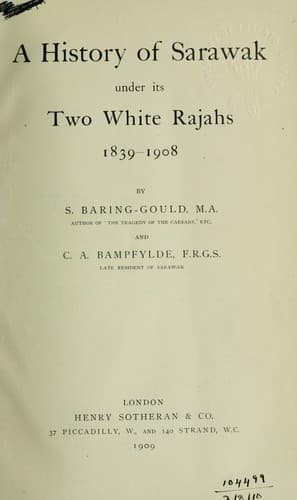
A History of Sarawak under Its Two White Rajahs 1839-1908Baring-Gould, S. (Sabine)
History
A History of Sarawak under Its Two White Rajahs 1839-1908
Baring-Gould, S. (Sabine)
Charles, Rajah of Sarawak, 1829-1917; James, Rajah of Sarawak, 1803-1868; Sarawak (Malaysia) -- History
As a commentary on Mr. Cobden's assertion that the natives were being
driven out of Sarawak, the population of the raj in 1850 had increased
to 50,000 from 8000 in 1840, and this increase was due to immigration
from the neighbouring countries, where the people had been the constant
prey of pirates, head-hunters, and their own oppressive rulers, and for
these over-burdened people the Rajah had supplied a haven. The Chinese
colony in upper Sarawak was augmented by the arrival of five thousand
Chinese refugees from Pemangkat in Dutch territory, who had come to
Sarawak to escape the tyranny of their more powerful neighbours and
rivals, the Chinese of Montrado. These latter had successfully rebelled
against the authority of the Dutch, and were now oppressing their weaker
neighbours, both Chinese and Dayak. The Kayan and Kenyahs of the Baram,
who had been in rebellion against the Sultan, had sent messages offering
to accept the Rajah as their chief, and those of the Rejang assisted in
building the new fort at the mouth of the Kanowit. This fort was erected
by the Rajah to protect the inhabitants of the Rejang delta, and of Oya
and Muka, by blocking the egress by the Kanowit river to the Sekrang and
Saribas Dayaks. All these countries, including the Sekrang, where a
station had already been established, were under the _de jure_ rule of
the Sultan, but the inhabitants now looked upon the Rajah as their
ruler. The Sultan had long been helpless to govern the disturbed
districts; his authority was not recognised by the population, and the
chiefs appointed by him acted to gain their own ends, the enriching of
themselves at the expense of the people. The Sultan had placed himself
in the Rajah's hands, and was well pleased that he should pacify and
introduce order into these districts, more perhaps in his own interests
than in those of his own people, for whose welfare he cared little; they
paid him no revenue, and that he hoped the Rajah would secure for him.
Bandar Kasim, in spite of warnings, was again oppressing his people in
the Sadong. The Rajah had deposed him in 1848, and had appointed his
brother, Abang Leman,[176] in his place, but the change brought no
benefit to the people, it gave them but an additional tyrant, for both
were now behaving badly, and the Bandar had to be removed.
After visiting Labuan, the Rajah went to Penang for a much-needed
change, and there received instructions from the Foreign Office to
proceed to Siam on a diplomatic mission. He left for Bangkok in August.
To quote his own words: "The mission was a dead failure, as the Siamese
are as hostile and opposed to Europeans as any people can well be. I had
a very trying time of it, and altogether got rid of an unpleasant and
critical position without loss of national and individual credit." A
short time before an American mission had also been similarly repulsed.
Public-domain text, read in full here on John Shaqi.
Reviews
Reviews
No reviews yet
Be the first to share your thoughts on this work.
Elsewhere in the archive
Join the Discussion
Join the discussion
Sign in to leave a comment or review.
Sign InorCreate an account