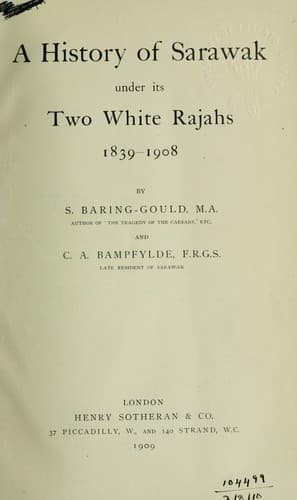
A History of Sarawak under Its Two White Rajahs 1839-1908Baring-Gould, S. (Sabine)
History
A History of Sarawak under Its Two White Rajahs 1839-1908
Baring-Gould, S. (Sabine)
Charles, Rajah of Sarawak, 1829-1917; James, Rajah of Sarawak, 1803-1868; Sarawak (Malaysia) -- History
British subject; was the Rajah engaged in trade? and whether the Rajah
should be entrusted with a discretion to determine which tribes are
piratical, and to call for the aid of her Majesty's Naval forces for the
punishment of such tribes, were points upon which the Commissioners had
to decide, and upon which they differed. They, however, agreed that the
Rajah was not engaged in trade, and the other questions, except the
involved one of the independence of Sarawak, had been solved by the
Rajah's resignation of his appointments under the Crown, which was,
however, only accepted late in 1855, long after he had in weariness of
spirit ceased to exercise the functions of those offices.
"Upon the question of the independence of Sarawak, Mr. Prinseps found
the Rajah's position to be no other than that of a vassal of the Sultan,
holding indeed by a tenure very bare, and easy to be thrown off
altogether." Mr. Devereaux could give no definite opinion; but it was a
question to be submitted only to the highest legal authorities, and the
Rajah justly protested against the Commissioners dealing with it; and it
is a question that has long since been settled.
One result of this senseless outcry in England against the Rajah was
that no help was thenceforth accorded him by the fleet in the China and
Straits waters. Were an insurrection to take place; were the Sekrangs
and Saribas to send round the calling-out spear and muster their clans,
not a marine, not a gun would have been afforded him by her Majesty's
Government for his protection, and such was the case during the Chinese
insurrection.
An evidence of the confidence felt after the quelling of the pirates was
the increase in trade, the tonnage of merchant vessels in 1852 having
risen to 25,000 tons, whereas in 1842 the whole trade was carried on by
a few native prahus. Traders were secure along the coast, and, as was
testified to before the Commission, the people of Sambas and Pontianak
blessed the Rajah for the protection he had given them against the
depredations of the piratical Dayaks; and those of Muka and Oya were
thankful that he had settled near them—a little later they had more
reason to be thankful, when he relieved them of their oppressive rulers.
The Singapore _Free Press_ in February, 1850, said:—
A few, a very few years ago, no European merchant vessels ventured
on the north-west coast of Borneo; now they are numerous and safe.
Formerly shipwrecked crews were attacked, robbed, and enslaved; now
they are protected, fed, and forwarded to a place of safety. The
native trade now passes with careless indifference over the same
track between Marudu and Singapore where, but a little while ago, it
was liable to the peril of capture; the crews of hundreds of prahus
are no longer exposed to the loss of life and the loss of property.
The recent successful proceedings on the coast of Borneo have been
followed by the submission of the pirate hordes of Saribas and
Sekrang.
Public-domain text, read in full here on John Shaqi.
Reviews
Reviews
No reviews yet
Be the first to share your thoughts on this work.
Elsewhere in the archive
Join the Discussion
Join the discussion
Sign in to leave a comment or review.
Sign InorCreate an account