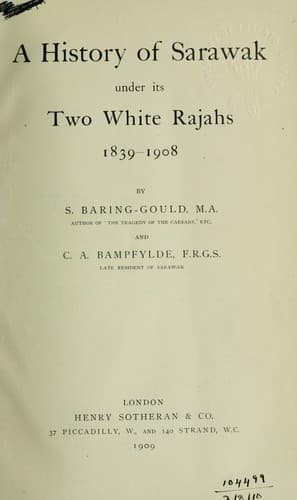
A History of Sarawak under Its Two White Rajahs 1839-1908Baring-Gould, S. (Sabine)
History
A History of Sarawak under Its Two White Rajahs 1839-1908
Baring-Gould, S. (Sabine)
Charles, Rajah of Sarawak, 1829-1917; James, Rajah of Sarawak, 1803-1868; Sarawak (Malaysia) -- History
But we will here briefly interrupt the sequence of events to give in
unbroken record the sequel that happily terminated the unprecedented
persecutions which the Rajah was subjected to for over five years, for
the miserable fiasco of the Commission, the direct result of these
persecutions, left the Rajah's defamers powerless and humiliated, and
the Government in a disgraceful dilemma.
The Commission sat in Singapore during the months of September and
October, 1854. It consisted of two gentlemen, Mr. C. R. Prinsep,
Advocate-General at Calcutta, already afflicted with the mental malady
to which he soon after succumbed, and the Hon. Humphrey B. Devereaux, of
the Bengal Civil Service. At the first and second meetings, of which due
notice had been given, to the surprise of the Commissioners no one
appeared to support the charges contained in the address to Mr. Hume,
and subpœnas had to be served on several of the subscribers to that
address. As a result, sixteen witnesses were produced in support of
these charges, and not one of them deposed to any acts within his own
knowledge which negatived the practice of piracy by the Saribas and
Sekrangs; three deposed to specific piratical acts of those tribes; and
one rather established than controverted their piratical character. On
the other hand, twenty-four witnesses called by the Commissioners, with
Mr. J. Bondriot,[182] late Resident of Sambas, Dutch Borneo (who
volunteered his evidence) deposed expressly to acts of piracy on the
part of these people. Traders and nakodas from Borneo, who were present
in Singapore, were deterred from coming forward to give evidence by
reports disseminated amongst them by the personal opponents of the Rajah
that their attendance would lead to detention and inconvenience. The
contention that the attacks of the Saribas and Sekrang Dayaks were
merely acts of intertribal hostility was not upheld. The charge of
wrongful and causeless attack and massacre wholly failed of proof, and
was sufficiently negatived.[183] This was the judgment of Mr. Prinseps,
and so far his brother Commissioner was with him, for, after dealing
with their general character, Mr. Devereaux sums up by saying that the
Saribas and Sekrang were piratical, and deserved the punishment they
received, and that in conflicts with such men atrocities, in the
ordinary sense of the term, are not easily committed.[184] These were
the main points which mostly concerned the public, and upon which were
based the grave accusations that it had been the pleasure of Mr. Hume
and his adherents to formulate upon totally inadequate and most
unreliable evidence. The other points brought by their instructions to
the notice of the Commissioners were matters more between the Crown and
the Rajah than of general interest to the public. Whether the position
of Sir James Brooke as Rajah of Sarawak was compatible with his duties
as British Consul General and Commissioner, and with his character as a
Public-domain text, read in full here on John Shaqi.
Reviews
Reviews
No reviews yet
Be the first to share your thoughts on this work.
Elsewhere in the archive
Join the Discussion
Join the discussion
Sign in to leave a comment or review.
Sign InorCreate an account