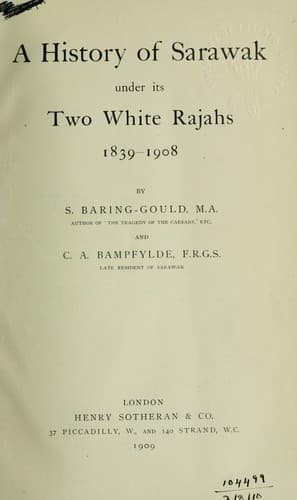
A History of Sarawak under Its Two White Rajahs 1839-1908Baring-Gould, S. (Sabine)
History
A History of Sarawak under Its Two White Rajahs 1839-1908
Baring-Gould, S. (Sabine)
Charles, Rajah of Sarawak, 1829-1917; James, Rajah of Sarawak, 1803-1868; Sarawak (Malaysia) -- History
In August, 1853, the Rajah went to Bruni, where he found that his power
and his popularity had not waned, though discarded by the British
Government, and discredited by his own countrymen, and though he arrived
in a small merchant ship instead of in one of her Majesty's men-of-war.
He stayed some time in Bruni, and was warmly received by the new Sultan,
Abdul Mumin, for Omar Ali had departed to answer for his sins, "and was
fully and firmly reinstated as their friend and adviser." Those
districts outside Sarawak, namely the Sadong, Batang Lupar, Saribas, and
Kalaka rivers and their tributaries, with a coast-line of some
seventy-five miles, in area about three times the size of the raj, were
now incorporated with it by a cession granted by the Sultan, the Rajah
agreeing to pay the Sultan half of any surplus revenues that might
accrue. We may note here for convenience that this was altered
afterwards in 1861, when the territories as far as Kedurong point were
ceded, thereby giving the State a further coast-line of 180 miles, and
the rivers Rejang, Oya, Muka, Tatau, and Bintulu. For this additional
cession and that of 1853 a fixed yearly sum was to be paid to the Sultan
as compensation for loss of revenue; and these cessions, having been
made subsequent to the treaty of 1847, contain a clause to the effect
that none of the districts ceded by them may be transferred by the Rajah
or his successors to any other government, company or persons without
the sanction of the British Government, but the Sultan's sanction is not
required. In the event of the cession money not being paid for three
consecutive years, the districts ceded would revert to the Sultan;
otherwise the sovereign and territorial rights over these districts are
absolutely invested in the Rajahs of Sarawak, the Sultan having reserved
no rights or power whatever over them. The cessions subsequently
obtained by the present Rajah, which will be noted in their proper
places, were granted on the same terms.
In December, the Rajah arrived at Lingga on his way to Sekrang and
farther up the river, with the object of opening up communication with
the turbulent members of the Dayak tribes in the interior, under Rentap
and Bulan. These chiefs were men of very different character, and headed
native bodies of like diversity.
Rentap was an active, crafty, and determined man, rootedly opposed to
the interference of Europeans and the putting down of piracy and
head-hunting. On the other hand, Bulan was the figure-head of a party
that hesitated, uncertain which direction affairs would take, and
watching to see which way the cat jumped. Bulan and his faction would
not engage in active hostility against the Rajah's government, unless
they saw that the tide of affairs was setting strong against it. But
also they would not profess friendship, or lend help against the
turbulent party.
Public-domain text, read in full here on John Shaqi.
Reviews
Reviews
No reviews yet
Be the first to share your thoughts on this work.
Elsewhere in the archive
Join the Discussion
Join the discussion
Sign in to leave a comment or review.
Sign InorCreate an account