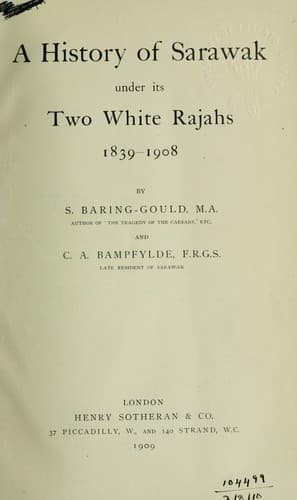
A History of Sarawak under Its Two White Rajahs 1839-1908Baring-Gould, S. (Sabine)
History
A History of Sarawak under Its Two White Rajahs 1839-1908
Baring-Gould, S. (Sabine)
Charles, Rajah of Sarawak, 1829-1917; James, Rajah of Sarawak, 1803-1868; Sarawak (Malaysia) -- History
The Tuan Muda attended the Rajah to Sekrang, and several meetings were
contrived with the leaders of the two factions, but with no satisfactory
results. In April, 1854, owing to the representations of Mr. Brereton,
an expedition was organised against a chief called Apai[194] Dendang at
Dandi, on the backbone or watershed between the Saribas and the Sekrang
river, a hotbed of mischief, whence several incursions had been made
into the pacified country, with the usual results of rapine and murder.
The Tuan Muda brought up a contingent from Lingga, and this, united with
a force from Kuching, proceeded up the Sekrang, passing troublesome and
dangerous rapids, till the point Lipat was reached, where the boats had
to be left. The backbone of hills was at some considerable distance, and
to reach it much thorny jungle had to be traversed. After a day's march
inland it was arranged that the Europeans and the Sarawak Malay
contingent should remain behind, and that a fighting division of Dayaks
should be sent forward under their chiefs to attack Dandi, which
consisted of one long Dayak house. The plan adopted was not the most
judicious, and the result was disappointing. We will describe what
followed in the Tuan Muda's own words.
Late in the afternoon of the third day, when we anxiously awaited
the return of the advanced division, our outposts first of all
descried two or three small parties of Dayaks evidently of our
force, wending their way slowly over hill and dale. On their nearer
approach, we plainly saw wounded men carried by them. Whispers
spread—gradually and quietly at first, but they soon became more
distinct—that our party had failed. In the evening the chiefs
arrived and came forward to report progress, looking haggard, thin,
and exhausted. The story was as follows—they had walked at a fast
pace the whole of the first day over the steepest hills, sometimes
without any path, and the guides at a nonplus for the proper
direction; from morning till night they scarcely halted, under a
scorching sun; and parched with thirst without any hope of water. At
night, by moonlight, they pushed on again, until they nearly fell
from exhaustion, when they slept in any position with their arms on.
About 3 A.M. they again advanced, and, at the opening of dawn, the
most active Dayaks, reaching the enemy's house, advanced upon it
without order, and as the leaders were mounting the ladder, they
were struck off one after another by hundreds of men inside, dressed
in fighting costumes, and headed by the whole of the Saribas tribe,
men heretofore on every occasion on land, victorious. Our poor
leaders had to retire to guard their wounded and dying, while the
enemy were yelling, cheering, and beating gongs; and even their
women, dressed in their best clothes, were clapping their hands, and
urging their sweethearts to the encounter.
Public-domain text, read in full here on John Shaqi.
Reviews
Reviews
No reviews yet
Be the first to share your thoughts on this work.
Elsewhere in the archive
Join the Discussion
Join the discussion
Sign in to leave a comment or review.
Sign InorCreate an account