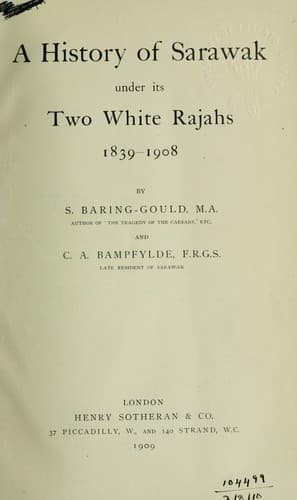
A History of Sarawak under Its Two White Rajahs 1839-1908Baring-Gould, S. (Sabine)
History
A History of Sarawak under Its Two White Rajahs 1839-1908
Baring-Gould, S. (Sabine)
Charles, Rajah of Sarawak, 1829-1917; James, Rajah of Sarawak, 1803-1868; Sarawak (Malaysia) -- History
As the sun rose, some of the strongest of the Malay force came up
within shot, and took up quarters behind trees and opened fire upon
the house. This stopped the cheering within, but in no way daunted
the enemy. About an hour after, our elderly chiefs came up, viewed
the house of the enemy, sat down on the hillside in a sheltered
position, and were so exhausted that children might have hacked
their heads off. They stopped all advance of their party, and while
the oldest chiefs were suffering severely from fatigue, a palaver
was opened, the result being that some of the enemy came down, mixed
with our people, then partook of sirih and betel-nut in a friendly
manner, and promised to show our party the nearest way back, and
provide them with provisions for their journey. On their part they
engaged to be answerable for the payment of a "death fine" for the
men they had killed some months previously.
News that a large expedition had been organised against Dandi had
reached Apai Dendang before the departure of the force from Sekrang, and
he had summoned to his assistance all the bravest men of the Saribas
tribe, and the principal leaders of every head-hunting expedition for
some time past; nevertheless he was unwilling to drive matters to an
extremity, having a wholesome dread of the white men. This rendered him
ready to treat and buy off the expedition with a promise of indemnity
for murders recently committed.
A fatal want of discretion had been shown in the whole affair, no
trustworthy guides had been engaged, no inquiry made as to whether the
Saribas were coming up to the succour of Apai Dendang, no English
leaders were sent forward with the rabble of assailants, and that rabble
had attacked in straggling detachments, when exhausted with hard
marching and with thirst.
We returned home with feelings that can be better imagined than
described. The Dayaks said that the omens had been bad from the
outset; the Malays said if they had only been there, the result
would have been different; and the Europeans said—nothing.
Public-domain text, read in full here on John Shaqi.
Reviews
Reviews
No reviews yet
Be the first to share your thoughts on this work.
Elsewhere in the archive
Join the Discussion
Join the discussion
Sign in to leave a comment or review.
Sign InorCreate an account