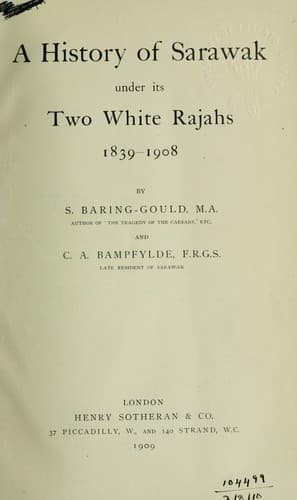
A History of Sarawak under Its Two White Rajahs 1839-1908Baring-Gould, S. (Sabine)
History
A History of Sarawak under Its Two White Rajahs 1839-1908
Baring-Gould, S. (Sabine)
Charles, Rajah of Sarawak, 1829-1917; James, Rajah of Sarawak, 1803-1868; Sarawak (Malaysia) -- History
We had Dayak guides, and could not have proceeded without them. Our
land force consisted mostly of Malays, and numbered about 500 men—
the Sekrang Dayaks were in their boats. About 4 P.M. we halted on
the brink of the river and prepared to spend the night with a
stockade around. This was in the enemy's country, although there
were many people living near who were neither the one thing nor the
other. The following morning we proceeded again in the same order,
but before mid-day many of our party were quite exhausted, and there
was really no road to follow but the muddy banks of the river, so we
halted, and after our mid-day meal it was decided that we were all
to crowd in with the floating force. And thus we pushed on, but in a
most comfortless condition with regard to space. We spent the night
at Tabbat, and fortified ourselves here also. My subsequent
experience of the localities has proved that we should never have
reached our destination on foot, keeping company with the boats. On
the fourth day we spied the enemy's position, situated on a hill
cleared of all old jungle and showing recent preparations of defence
around their dwellings. Our heavy armament consisted of 4- and
3-pounder guns and rocket tubes.
The enemy showed no opposition outside, and after marching about
four miles, we arrived at a hill in their vicinity. It was a fiery
hot morning without a cloud, and the hills, though low, were very
precipitous. The Europeans kept near the guns, to assist in their
progress up the steeps, and when we were mounting the last rising
ground on which the enemy was fortified, we found some of the
leaders of our force had foolishly advanced too near, and a few had
been killed and wounded, and were now being carried to the rear. The
enemy had two long houses on the ridge of a hill, surrounded by
steep ground excepting at the end. Here high stakes were driven into
the earth, and around all a firm and thick stockade. The 4-pounder
gun was mounted after considerable delay, and, when the rocket tube
was in place, we opened fire on one end, while the 3-pounder played
away on the other. The enemy answered our fire pretty briskly with
their lelahs.[196] We could see the men rushing to and fro covered
with their shields, also parties dancing to the music of the gongs.
Some of their voices we heard distinctly, saying they would never
succumb to the tight-breeched men (white men) or to any other
strangers. Mr. Crookshank (at considerable risk) took charge of the
rockets, which were of ancient make, and a few that were fired
entered the fort and did great execution, but the majority whizzed
round and round and sometimes lodged in the ground among our own
party; we were all more afraid of these missiles than anything the
enemy could produce. Early in the afternoon there was a commotion
among the enemy, and we could discern women and children leaving on
Public-domain text, read in full here on John Shaqi.
Reviews
Reviews
No reviews yet
Be the first to share your thoughts on this work.
Elsewhere in the archive
Join the Discussion
Join the discussion
Sign in to leave a comment or review.
Sign InorCreate an account