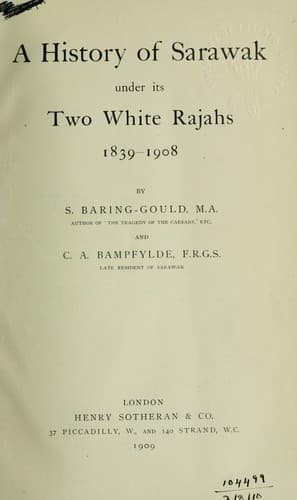
A History of Sarawak under Its Two White Rajahs 1839-1908Baring-Gould, S. (Sabine)
History
A History of Sarawak under Its Two White Rajahs 1839-1908
Baring-Gould, S. (Sabine)
Charles, Rajah of Sarawak, 1829-1917; James, Rajah of Sarawak, 1803-1868; Sarawak (Malaysia) -- History
the opposite side of the hill, but the men stood fast and kept their
posts.
Our old Penglima[197] was biding his time, for he yet knew that he
might lead, but others would not follow. He worked steadily and
quietly, amid many jeers from some of our own native party, who
asked why the warrior did not make an advance: his reply between his
teeth was—"Your words are more than your deeds." As the sun drew
near to the horizon, the Penglima moved up to the enemy's stockade,
silently opened the palisade, and, after a moment's peep, jumped in,
followed by others, who gave a loud cheer and drew their swords. The
enemy, finding a lodgment had been made inside, immediately took to
their heels and fled down the hill. We followed in close to the
leaders; the entrance was so narrow that many received contusions
when passing through. About fifty or sixty of the enemy were tearing
away over the open ground, covering their bodies with their shields.
These were followed by all the defenders of the stockade, who rolled
down the side of the hill, a living wave, bearing away with them their
chief Rentap, who had been wounded. The stockade was taken, and within
its defences the victors passed the night, whilst the enemy fled
precipitately to a second and still stronger fastness on the summit of
the mountain Sadok, which loomed in the distance. One of the most
curious and significant features of the conflict was that, whilst it was
in progress, the hills and every commanding position around were crowded
with Dayaks, the adherents of Bulan, as well as others, who watched it
with lively interest, taking no part on one side or the other, but
waiting to see to which side the scale would incline. Had the attacking
force met with discomfiture, these men would have fallen on it and
harassed the party as it retreated.
If, after the defeat of Rentap and the capture of the stockade in the
Lang, they did not tender allegiance to the Government, it was because
the expedition retired immediately after having achieved its first
success, and, therefore, it gave the waverers no permanent assurance of
protection against Rentap's resentment.
To have crushed Rentap, it would have been necessary to have pursued him
to his second stronghold at Sadok, but this was not done. Captain Brooke
in command doubtless saw the expediency of following up a routed foe,
but Dayak warriors are wont to rest content with a single victory, and,
that gained, to become uncontrollably impatient to return home; besides,
the force was in too disturbed a state to undertake any organised
attack; accordingly, after making a circuit of devastation, it returned.
The result was that Rentap continued to give trouble for seven years.
Public-domain text, read in full here on John Shaqi.
Reviews
Reviews
No reviews yet
Be the first to share your thoughts on this work.
Elsewhere in the archive
Join the Discussion
Join the discussion
Sign in to leave a comment or review.
Sign InorCreate an account