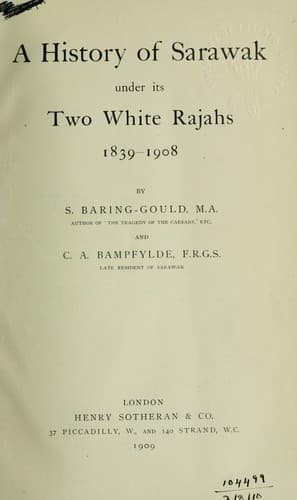
A History of Sarawak under Its Two White Rajahs 1839-1908Baring-Gould, S. (Sabine)
History
A History of Sarawak under Its Two White Rajahs 1839-1908
Baring-Gould, S. (Sabine)
Charles, Rajah of Sarawak, 1829-1917; James, Rajah of Sarawak, 1803-1868; Sarawak (Malaysia) -- History
Intertribal feuds, which had been more or less dropped in the common
cause of piracy—and the plethora of heads it afforded—had now broken out
again, and were growing in intensity. Besides these troubles in the
Batang Lupar and Saribas, the Dayaks of the Rejang living on the Serikei
and Kajulau rivers were giving considerable trouble. These Dayaks had
moved over from the Sekrang and Saribas and were hand-in-glove with
Rentap's rebels. They were open and declared enemies of the Government.
The Kajulau was considered to be the centre of the enemy's country, and
also to be inaccessible to attack. Confident in their impunity, they
were becoming a terror to the peaceable inhabitants of the Rejang delta,
so the Tuan Muda determined to attack them, and organised an expedition—
the first to act independently of Kuching assistance, except for the
loan of the dozen old muskets above mentioned.
On June 6, 1856, the force, comprising a few Malays, and some 3000
Dayaks, started. To take the enemy by surprise the Tuan Muda decided to
go up the Kalaka and march overland. Though the Malays of this river had
suffered severely at the hands of the Kajulaus, they at first refused to
accompany the expedition, regarding the difficulties as insuperable, and
the danger as overwhelming. The result was that half the Malay force the
Tuan Muda had brought with him were intimidated, and began to cry off;
but Abang Aing restored their confidence, and shamed the Kalakas into
accompanying the expedition. On the 14th, after having encountered great
difficulties in passing the rapids, the force reached the Budu stream,
and here the boats were left, but as there were enemies ahead and
enemies to the right (the Saribas) a strong stockade was erected and
garrisoned, to serve as a base and to guard the rear. Near this base
were two long Dayak houses, and in one of them was staying a notorious
Saribas Dayak chief named Saji. As the people were not declared enemies,
though very doubtful friends, Saji could not be touched, but he remained
a danger to be reckoned with, and against whom precautions had to be
taken, for as soon as the expedition started overland he would be able
to follow it with hundreds of men. But Saji was cautious. He preferred
to wait to make his attack till the return of the expedition, when it
would be easier to surprise, for, if not defeated, it would probably be
disorganised. The march commenced on the 16th. The bala formed in three
columns with the Malays in the centre, and at evening the tawaks (gongs)
of the enemy could be heard in the distance sounding the alarm. But it
was not until the 18th, after a tedious march over hilly land, that the
verge of the enemy's country was reached. At 3 P.M. a sharp encounter
took place, and the enemy were driven off, leaving a few dead on the
field, and several long houses that had been abandoned in haste were
entered and plundered. One of these houses the Tuan Muda occupied; and,
Public-domain text, read in full here on John Shaqi.
Reviews
Reviews
No reviews yet
Be the first to share your thoughts on this work.
Elsewhere in the archive
Join the Discussion
Join the discussion
Sign in to leave a comment or review.
Sign InorCreate an account