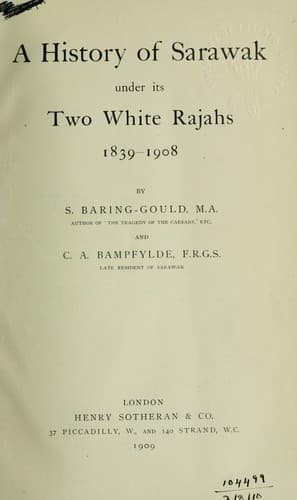
A History of Sarawak under Its Two White Rajahs 1839-1908Baring-Gould, S. (Sabine)
History
A History of Sarawak under Its Two White Rajahs 1839-1908
Baring-Gould, S. (Sabine)
Charles, Rajah of Sarawak, 1829-1917; James, Rajah of Sarawak, 1803-1868; Sarawak (Malaysia) -- History
finding that the enemy, taken by surprise, attempted no attack and
offered no organised resistance, the force was divided up and despatched
in different directions under their own leaders to burn and destroy.
Here an episode occurred which nearly proved disastrous. On the
afternoon of the 19th, an attack was expected, and the house occupied by
the Tuan Muda was greatly crowded with warriors to defend it. At 7
o'clock it was observed that the posts supporting the house were sloping
considerably, and it was found that this had been caused by the Dayaks
having stowed away in it overmuch of their heavy plunder, such as brass
guns, jars, and gongs, and hundreds had gone up into the house, though
by custom they ought to have remained without on the ground. A collapse
would have meant the loss of many lives, and would have been taken
advantage of by the watchful enemy. Upon the insistence of Abang Aing,
the Tuan Muda left the house, and the Malays were directed to turn the
Dayaks out instantly. But this was by no means easy to be done; indeed
the Dayaks resisted being made to evacuate the house and leave their
plunder there.
Whilst the Tuan Muda was sitting out in the moonlight, a sudden din and
the sounds of strife arose from the house. Men came flying down the
ladder, and others hurried up it. Then three Balau Dayak chiefs begged
the Tuan Muda to go up immediately. Against the protests of Abang Aing,
with sword and gun in hand, he ascended, and found Dayaks and Malays in
a heated and dangerous condition, opposed to one another with drawn
swords in their hands. Planting himself between the antagonists, the
Tuan Muda ordered silence, and cocking his double-barrelled gun and
placing the muzzle within two inches of the leading Dayak's head, he
ordered him to leave the house. Amidst a dead silence the chief went,
followed by the Tuan Muda, the Dayaks edging away and making a path for
them along the verandah to the ladder. Thus ended the disturbance, and
by the morrow it was forgotten. It was arrested just in time to prevent
a desperate encounter between the Malays and Dayaks, which would have
been taken up by the other Dayak factions—for in the bala were Dayaks of
different tribes, only held together by the controlling influence of
their white chief—and there would have been fighting among themselves.
The enemy, taking advantage of this, would have fallen upon and routed
them, and the survivors flying to regain the boats would have been cut
off by Saji and his Saribas. The power of the Government among the
Sea-Dayaks would have been broken completely, and it would have taken
many years to recover it, a calamity which was averted by the bold and
prompt action of the Tuan Muda, and his personal power over Malays and
Dayaks alike.
Public-domain text, read in full here on John Shaqi.
Reviews
Reviews
No reviews yet
Be the first to share your thoughts on this work.
Elsewhere in the archive
Join the Discussion
Join the discussion
Sign in to leave a comment or review.
Sign InorCreate an account