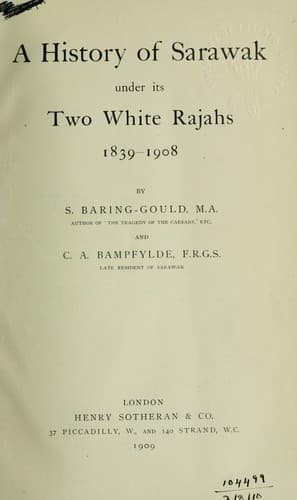
A History of Sarawak under Its Two White Rajahs 1839-1908Baring-Gould, S. (Sabine)
History
A History of Sarawak under Its Two White Rajahs 1839-1908
Baring-Gould, S. (Sabine)
Charles, Rajah of Sarawak, 1829-1917; James, Rajah of Sarawak, 1803-1868; Sarawak (Malaysia) -- History
Accordingly the Tuan Muda hastened to Kuching, but found that all was
quiet there, and it was supposed that the reports were unnecessarily
alarming. Thus satisfied, he departed, and returned to Sekrang. Mr.
Arthur Crookshank, then in charge at Kuching during the absence of the
Rajah and the Tuan Besar, who was in England, however, took the
precaution to man the small stockades, which constituted the only
defences of the town, with a sufficient garrison.
On February 14, 1857, four days before the insurrection broke out, a
Chinaman, who had formerly been expelled from Sarawak territory for
joining a secret society, appeared in Bruni, and was detected attempting
to induce the Chinese servants of Mr. Spenser St. John, then
Consul-General there, to enter the Thien-ti Secret Society; and
encouraging them to do so with the assurance that a general massacre of
the white men in Sarawak was in contemplation, and that the Chinese
would establish their own supremacy there. It is therefore by no means
improbable that he was an agent of the Kongsi sent to Bruni, to
communicate the plan of insurrection to Makota. Moreover, it was
ascertained that overtures had been made to certain disaffected Malays
in Sarawak to shut their eyes, if they did not feel inclined for actual
co-operation in the attempt.
On the Rajah's return to Kuching from Singapore, Mr. Crookshank told him
of the disquieting rumours, and of what he had done for the protection
of the capital. And, although Mr. Middleton, the Inspector of Police,
confirmed his opinion that precautions should be taken, the Rajah could
not be induced to believe that there was danger, and unwisely dismissed
the garrison from the forts, and no efficient watch was kept.
On February 18, the chief of the Kongsi assembled about six hundred of
the ablest-bodied Chinamen belonging to the Society at Bau, armed them
and marched to Tundong on the Sarawak river, where a squadron of large
boats had been prepared to carry them to Kuching.
Public-domain text, read in full here on John Shaqi.
Reviews
Reviews
No reviews yet
Be the first to share your thoughts on this work.
Elsewhere in the archive
Join the Discussion
Join the discussion
Sign in to leave a comment or review.
Sign InorCreate an account