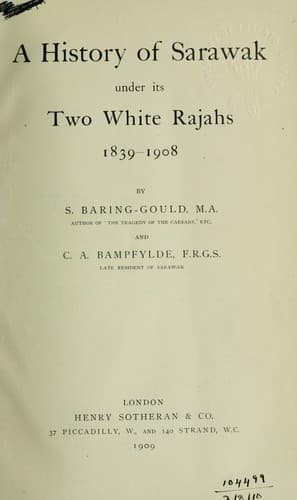
A History of Sarawak under Its Two White Rajahs 1839-1908Baring-Gould, S. (Sabine)
History
A History of Sarawak under Its Two White Rajahs 1839-1908
Baring-Gould, S. (Sabine)
Charles, Rajah of Sarawak, 1829-1917; James, Rajah of Sarawak, 1803-1868; Sarawak (Malaysia) -- History
In October, 1856, trouble with China began, and Commissioner Yeh,
defying Sir John Bowring and Admiral Seymour, publicly offered a reward
of thirty dollars for every English head. Rumour of this, greatly
magnified into a general slaughter and expulsion of the English, had
reached the Chinese in Singapore, where an outbreak took place in 1857,
and Sarawak, where signs of unrest among the Chinese became apparent.
The Commission of Inquiry into the conduct of the Rajah greatly tended
to encourage the Chinese to revolt. They believed that the British
Government strongly disapproved of the rule of the Rajah, and would not
lift a finger to maintain it. There was but a handful of white men in
Sarawak, and the Land-Dayaks were well known to be a timorous people,
indisposed to war. It was also thought that there was a body there of
disaffected Malays, under the influence of the Rajah's old adversary,
the Pangiran Makota, who was now supreme in Bruni, governing the mind of
the imbecile Sultan, and watching for every opportunity of upsetting the
rule of the English Rajah in the south.
The headmen of the Kongsi accordingly resolved upon striking a sudden
blow, mastering Kuching, and sweeping the Rajah and all his officials
out of the place. But, so as not to give occasion to the British
Government to interfere, they determined to massacre them only, and to
spare the lives of the few English merchants and missionaries resident
at Kuching, and not members of the Rajah's staff.
At the close of 1856, the Rajah was at Singapore, whither he had gone to
recruit, as he was much out of health. His nephew, the Tuan Muda, was at
Sekrang, engaged on the construction of a new fort, when he received a
letter from the principal official in Kuching, requesting him to be
present at the Chinese New Year, and informing him that he had received
disquieting intelligence about the Chinese gold-miners, who, under the
plea of erecting a new joss or idol, or Tai-pi-kong,[212] meditated an
attack on Kuching, and an attempt to overthrow the Government and
establish their own independent rule. The Tuan Muda at once sought Abang
Aing, the principal Sekrang chief, a man to be thoroughly trusted, but
he was laid up with small-pox, and unable to help.
"He spoke very kindly and to the purpose, telling me plainly that he did
not like the sound of the reports, and begged me to be careful. He
regretted that he could not go himself, but would send a younger
brother, and urge the Orang Kaya to accompany me, and he promised to
arrange so as to follow me if anything serious really occurred. No
Christian could have offered advice in a kinder tone or better spirit."
Public-domain text, read in full here on John Shaqi.
Reviews
Reviews
No reviews yet
Be the first to share your thoughts on this work.
Elsewhere in the archive
Join the Discussion
Join the discussion
Sign in to leave a comment or review.
Sign InorCreate an account