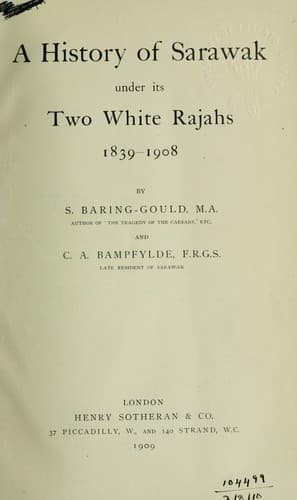
A History of Sarawak under Its Two White Rajahs 1839-1908Baring-Gould, S. (Sabine)
History
A History of Sarawak under Its Two White Rajahs 1839-1908
Baring-Gould, S. (Sabine)
Charles, Rajah of Sarawak, 1829-1917; James, Rajah of Sarawak, 1803-1868; Sarawak (Malaysia) -- History
The Rajah as soon as possible proceeded to the Datu Bandar's house,
and being quickly joined by his English officers, endeavoured to
organise a force to surprise the victorious Chinese, but it was
impossible. No sooner did he collect a few men than their wives and
children surrounded them and refused to be left,—and being without
proper arms or ammunition, it was but a panic-stricken mob; so he
instantly took his determination with that decision which had been
the foundation of his success, and giving up the idea of an
immediate attack, advised the removal of the women and children to
the left-hand bank of the river, where they would be safe from a
land attack of the Chinese, who could make their way along the
right-hand bank by a road at the back of the town.[217]
By the morning the women and children had been moved across, and the
Rajah and his officers, having been joined by Abang Buyong[218] and some
armed Malays, proceeded to the Samarahan, intending to go on to the
Batang Lupar, and fall back on the well-equipped forts there to organise
a force to drive out the rebels.
The next morning the Chinese chiefs summoned the Bishop; Mr. L. V.
Helms, Manager of the Borneo Company Limited; Mr. Rupell, a merchant,
and the Datu Bandar, to appear before them in the Court-house. Seated on
the Rajah's chair, the head Chief, supported by his secretaries, issued
his orders that Mr. Helms and Mr. Rupell were to rule the foreign
portion of the town, and the Datu Bandar the Malays, under the Kongsi as
supreme rulers. The Bishop now warned the Chinese that they were playing
a desperate game, that the Tuan Muda would be coming down upon them,
with his host of Sekrang and Balau warriors, to avenge the death of his
uncle and his friends—for most of them supposed the Rajah dead.
Discouragement fell upon the Chinese, for they remembered that the Tuan
Muda was the daring and popular leader of the Sea-Dayaks, and could
bring many thousands of these wild warriors against them. They therefore
decided to send him a letter to the effect that they would not interfere
with him so long as he did not interfere with them, and confined himself
to the districts under his government.
[Illustration:
OLD CHINESE TEMPLE, KUCHING.]
The leaders also knowing that the Rajah was not killed, had offered a
large reward for his capture, dead or alive, for what he was preparing
they knew not. They were now doubly anxious to leave Kuching with their
plunder, they therefore called upon the Europeans and the Malay chiefs
present to swear fidelity to the Kongsi, and this they were forced to do
under fear of instant death.
Public-domain text, read in full here on John Shaqi.
Reviews
Reviews
No reviews yet
Be the first to share your thoughts on this work.
Elsewhere in the archive
Join the Discussion
Join the discussion
Sign in to leave a comment or review.
Sign InorCreate an account