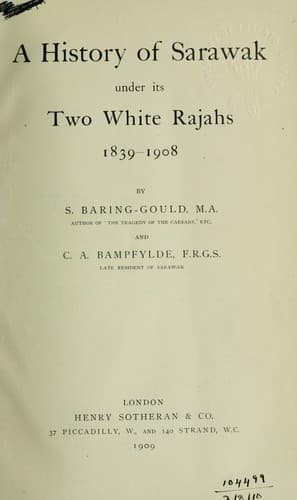
A History of Sarawak under Its Two White Rajahs 1839-1908Baring-Gould, S. (Sabine)
History
A History of Sarawak under Its Two White Rajahs 1839-1908
Baring-Gould, S. (Sabine)
Charles, Rajah of Sarawak, 1829-1917; James, Rajah of Sarawak, 1803-1868; Sarawak (Malaysia) -- History
The next day at noon the Chinese retired up-river with their boats
heavily laden with cannon, rifles, plate, money, and all the valuables
upon which they could lay their hands. The Malay chiefs at once held a
meeting at the Datu Bandar's house, when sturdy Abang Pata, the Datu
Temanggong's son, avowed his determination to remain faithful to the
Rajah and at once to wreck vengeance on his enemies. Though all were as
faithful, wiser counsels prevailed, the Malays being so scattered,
conveying their women and children to places of safety, that no
organised attack could yet be made; but Pata impetuously dashed off with
a dozen men in a small canoe, and following the Chinese, captured one of
their boats, killing five of the crew. This, and the news reaching them
that the Malays were preparing to resist, brought the Chinese back,
recruited by several hundreds from Upper Sarawak, and the agriculturists
of Segobang, whom they had forced to join them, and when the Rajah
returned at the earnest request of the chiefs to lead them against the
Chinese, a request he complied with, though he knew it was useless, he
found the rest of the English flying, the town in the hands of the
Chinese, and the Malay houses burning.
As soon as the Chinese boats were seen rounding the point above the
town, the Malays gallantly dashed at them, and succeeded in capturing
ten of their largest barges. They were, however, pressed back by the
more numerous and better armed Chinese, and, though they lost heavily,
they doggedly retreated retaining their prizes, which were laden with
valuable plunder, and, what was of more use to them, a quantity of arms
and ammunition, and secured them to a large trading vessel anchored in
the centre of the river. Here they maintained a determined resistance,
which they were now better able to do, and effectually defied the
Chinese to dislodge them. They were commanded by the Datu Bandar
Muhammad Lana, a grave and gentle Malay, who now showed the courage of
his father, the late Datu Patinggi Ali. The Chinese still held the town
in force.
The Rajah was again forced to retire, to carry out his original
intention of rallying his people up the coast, but his first care was to
see to the safety of the ladies, the English non-combatants, and the
wounded, and to send them off to safety at Lingga fort under the care of
the Bishop in a schooner. Despondently he prepared next day to follow
with a small flotilla of Malay boats, but at the mouth of the river, to
his intense relief, the Borneo Company's steamer, the _Sir James
Brooke_, arriving from Singapore, met them. The vanguard of the Tuan
Muda's force, which was quickly coming to his relief, was also arriving,
and now the tide had changed, and the day of reckoning had come.
Public-domain text, read in full here on John Shaqi.
Reviews
Reviews
No reviews yet
Be the first to share your thoughts on this work.
Elsewhere in the archive
Join the Discussion
Join the discussion
Sign in to leave a comment or review.
Sign InorCreate an account