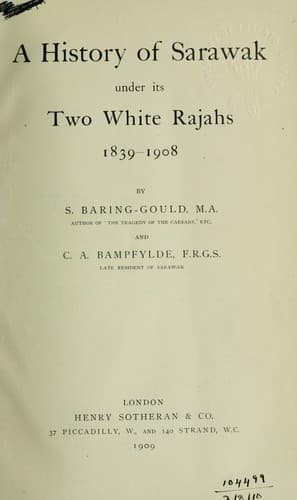
A History of Sarawak under Its Two White Rajahs 1839-1908Baring-Gould, S. (Sabine)
History
A History of Sarawak under Its Two White Rajahs 1839-1908
Baring-Gould, S. (Sabine)
Charles, Rajah of Sarawak, 1829-1917; James, Rajah of Sarawak, 1803-1868; Sarawak (Malaysia) -- History
The sight of the steamer and the Dayak bangkongs eagerly following was
quite sufficient for the Chinese. They fired one wild volley, and fled
panic-stricken, with the ships' guns playing on them, and pursued by the
Dayaks and Malays.
The Datu Bandar's gallant band on board the trader and in war-boats
around her had stood their ground in spite of heavy guns having been
brought to bear upon them, and they now assumed the offensive. The
Chinese, that morning, had crossed the river to destroy the Malay town
on the other side; their boats were now seized, and the Dayaks pursued
them into the jungle. Of that large party, not one can have escaped.
Those who were not killed wandered into the jungle and died of
starvation, or hanged themselves. Their bodies were eagerly sought for,
as on many were found from five to twenty pounds sterling, besides
silver spoons, forks, or other valuables, the plunder of the English
houses.
The main body of the Chinese retired by road to Segobang, and from
thence up-river in their boats.
We have already recorded how the news had been brought to the Tuan Muda
at Sekrang, and how he hurried with his Dayaks to the Rajah's rescue, to
find him safe and in good health, though crippled by the injuries he had
received, on board the _Sir James Brooke_, which he had made his
headquarters. Kuching was wrecked—"a mass of ashes, and confusion and
ruin lay around. Half-habitable débris of houses only were left. The
trees for many hundred yards around the fires were nearly all burnt
black and leafless, and those remaining alive were drooping," so the
Tuan Muda wrote, and we will now follow his account of the retribution
which the rebels so deservedly met.
To check the pursuing boats of the Dayaks and Malays, the Chinese had
thrown up a strong stockade at Lidah Tanah (lit. the tongue of land), a
point of land at the junction of the right and left hand branches of the
river. Here they placed a picked garrison under trusted leaders, and the
stockade was well armed with guns and rifles that had been taken from
Kuching.
A small force of Malays, and several hundreds of Sekrang and Saribas
Dayaks were organised to attack it, and the mild Datu Bandar, in his new
rôle of a redoubtable warrior, led them with such dash that the position
was soon carried. Amongst the trophies that were brought back by the
Dayaks the Chinese merchants recognised the heads of some of the
principal leaders of the rebels, and showed marked satisfaction that
such was the case.
The Rajah and the Tuan Muda then pushed on to Belidah, about eight miles
above Lidah Tanah. Here the fort was found to have been destroyed, the
rebels having left little behind them in their retreat but desolation
and misery. The Malays and Dayaks were then despatched under Abang
Buyong to attack the Chinese, but these latter were in full retreat from
Bau, and their other villages, towards the border; once across they
would be safe:
Public-domain text, read in full here on John Shaqi.
Reviews
Reviews
No reviews yet
Be the first to share your thoughts on this work.
Elsewhere in the archive
Join the Discussion
Join the discussion
Sign in to leave a comment or review.
Sign InorCreate an account