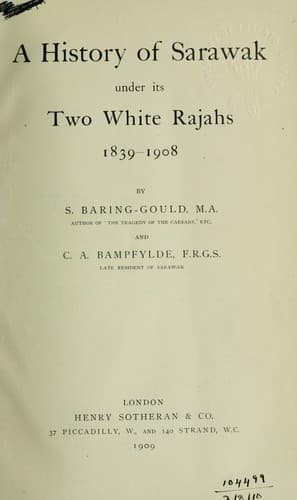
A History of Sarawak under Its Two White Rajahs 1839-1908Baring-Gould, S. (Sabine)
History
A History of Sarawak under Its Two White Rajahs 1839-1908
Baring-Gould, S. (Sabine)
Charles, Rajah of Sarawak, 1829-1917; James, Rajah of Sarawak, 1803-1868; Sarawak (Malaysia) -- History
But no sooner were they there than those of the Chinese who did not
belong to the Secret Society, filled with resentment against the members
of that league for having involved them in such disaster, fell upon
them, and killed many of them, reducing the hundred of the original band
of 600, who had survived the muskets and spears of the Dayaks, to
between thirty and forty. To add to their discomfiture, the Dutch
officers came upon them and despoiled them of all the arms and plunder
they had succeeded in bringing with them, and placed them under strict
surveillance. The Dutch Government sent back to Kuching everything which
was considered to be public or private property.[220]
How many of the rebels were killed it has not been possible to estimate,
but it could not have been far short of 1000. Sir Spenser estimates that
2000, of which half were women and children, escaped over the borders,
but this is probably an under-estimate.
"It was the madness," wrote the Rajah, "the stark staring folly of the
attempt that caused it to succeed. With mankind in general we may trust
to their not doing anything utterly opposed to reason; but this rule
does not hold good with the Chinese," who in their blindness of
consequences become daring and audacious, and, when possessed of power,
contemptuous of their adversaries, but who lose spirit on the first
reverse.
April 15, witnessed the closing scene of the drama. A prahu gaily
decorated with flags and the yellow umbrella, the symbol of authority,
went up and down the river. A gong was beaten, and then a man, standing
among the flags and umbrella, proclaimed peace, and announced that all
danger was at an end, and that every one might now put away his arms.
On March 28, when peace had been restored, H.M.S. _Spartan_ arrived,
under Captain Sir William Hoste, from Singapore, with instructions to
protect British lives and property, but with no orders to fire a gun, or
to lend a marine or blue-jacket for the protection of the Sarawak
Government. There was no knowing what the humanitarians at home might
say, should a finger be held out to assist the Rajah. Those who lifted
up their voices to justify the pirates might now espouse the cause of
the Chinese, and again be loud in condemnation of the Rajah for having
summarily suppressed the insurrection. There will always be found a man,
as says Cordatus in Ben Jonson's _Every Man out of his Humour_, "who
will prefer all countries before his native," and thinks every man right
except an Englishman.
The Dutch Resident at Pontianak behaved very differently from the
English authorities. He at once sent a gunboat and troops to Sarawak
with offers of assistance, which, however, were not then required.
Public-domain text, read in full here on John Shaqi.
Reviews
Reviews
No reviews yet
Be the first to share your thoughts on this work.
Elsewhere in the archive
Join the Discussion
Join the discussion
Sign in to leave a comment or review.
Sign InorCreate an account