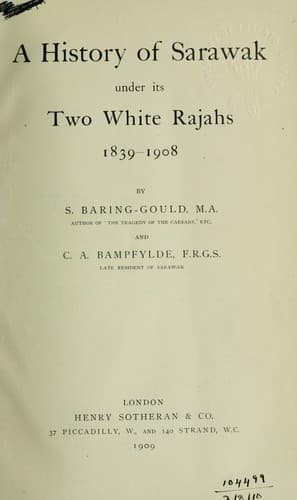
A History of Sarawak under Its Two White Rajahs 1839-1908Baring-Gould, S. (Sabine)
History
A History of Sarawak under Its Two White Rajahs 1839-1908
Baring-Gould, S. (Sabine)
Charles, Rajah of Sarawak, 1829-1917; James, Rajah of Sarawak, 1803-1868; Sarawak (Malaysia) -- History
The rebellion was "the direct outcome of the loss of prestige and
strength which followed the appointment of the Commission sent to try
the Rajah for high crimes and misdemeanours, the favourable findings of
which had never been brought home to the native mind by any act of
reparation made by the British Government."[221] The Chinese knew that
the Rajah had been left to his fate by his country, and, as _The Times_
commented,—
had they (the Chinese) had the opportunity of reading recent debates
in the British Parliament, their more subtle spirits might have
received further encouragement from the belief that we were not only
an ultra-peaceful, but an ultra-punctilious people, and that the
cutting of Rajah Brooke's throat and the burning of the town might
be considered matters beyond our cognizance, until the precise
colonial status of Sarawak was determined, and whether a Kunsi
Chinese (_sic_, Chinese Kongsi) was under the jurisdiction of any
British court.
And, the _Daily News_, which through ignorance of the true circumstances
had voiced the hostile opinion of the cranks against the Rajah in the
matter of the suppression of the Saribas and Sekrang pirates, was candid
enough to admit
having in the earlier part of Sir James Brooke's career felt it our
duty to express our dissent from, and disapproval of, certain parts
of his policy, we have sincere pleasure in proclaiming our
unreserved admiration of the manner in which he must have exercised
his power to have produced such fruits.
But it was precisely that part of his policy that had been condemned by
Mr. Gladstone and the _Daily News_ which had produced these present
marked effects.
The condition of the Sarawak Government was now serious, and surrounded
with difficulties. The revenue was gone. There was not a shred of a
document extant to tell the tale of former times. So complete was the
ruin that the Rajah had to wear native costume, which he borrowed here
and there.
But there was a bright spot amid the gloom, in the devotion of the
natives; their sympathy, their kindness, their entire willingness to
do what they could, are all balm to a wounded spirit. We have lost
everything but the hearts of the people, and that is much to
retain.[222]
The fidelity of the natives of all races and classes was exemplary. They
everywhere took up arms to support the Rajah and their Government, and
had the Chinese been twenty times as numerous, they would have been
driven out.
Public-domain text, read in full here on John Shaqi.
Reviews
Reviews
No reviews yet
Be the first to share your thoughts on this work.
Elsewhere in the archive
Join the Discussion
Join the discussion
Sign in to leave a comment or review.
Sign InorCreate an account